Quick Start
Start →
Run your first scan in 30 minutes
A screenshot-by-screenshot walkthrough, from a cold install to your first board-ready report.
Most teams just have not updated the spreadsheet. Four numbers explain why the old playbook fails, and what each one changes inside CVEasy.
The window between disclosure and weaponization collapsed from 1.6 years in 2020 to 21 days in 2025, and for headline CVEs in July 2026 it is now measured in hours. Quarterly scan cycles were built for the first number.
Which is why CVEasy syncs your connectors on a schedule measured in minutes, not quarters. Connect →
Barely one in a hundred disclosed vulnerabilities is ever exploited in the wild, but the ones that are get operationalized fast and hit hard. Teams that treat every Critical as equal spend 99% of their effort on the wrong list.
Which is why TRIS scores your environment, not the global average. Score →
The same exposure arrives three to five times, under a different name and severity from every product you own. Merged on asset identity and grouped by the fix that closes them, teams see around a 75% reduction in ticket volume. Every surviving ticket is actionable, and fewer tickets in the queue means fewer SLAs quietly breaking.
Which is why every finding becomes one exposure with witnesses, not five tickets. Validate →
Most platforms end at a ranked PDF, and the funnel from reported to ticketed to fixed inside SLA leaks at every stage. The distance between "we told you" and "it is fixed" is the metric your board actually cares about, and almost nobody measures it.
Which is why the ranked list becomes work orders that push through your patch tools, with SLA timers attached. Fix →
Weaponization and exploitation figures: published industry exploit-intelligence research. Ticket reduction: measured average across CVEasy deployments. Remediation funnel: illustrative.
158 out-of-the-box integrations across 15 categories. 135 bring findings in: 78 native API clients pull on a schedule you set, 43 file imports auto-detect on drop, and 14 push endpoints accept whatever your pipeline sends. The other 23 carry work back out to your ticketing, patch and chat tools, or ship built in as data feeds. The same vulnerability reported by three tools becomes one exposure with three witnesses.
Featured native API clients with full asset identity and control telemetry, not CSV exports.
Code, dependency, and cloud findings land in the same graph as your infrastructure vulns.
Drop an export or point any tool's output at the ingest API and it lands normalized.
Threat intelligence in, notifications out, and a native MCP server for Claude.
158 integrations across 15 categories
TRIS™ 3 · True Risk Intelligence Score
0 TO 100CVSS alone misses context. TRIS 3 starts from the likelihood a CVE lands on CISA KEV, fitted on EPSS, CVSS, age, network reachability and vendor reports of exploitation, then adds your asset context: criticality, crown jewels, internet exposure, environment and spread. Confirmed exploitation lifts a finding into ACT, and verified controls bring it down. Adding risk never lowers the score, and every score maps to an action band and SLA.
No account, no install: TRIS Lab runs in your browser.
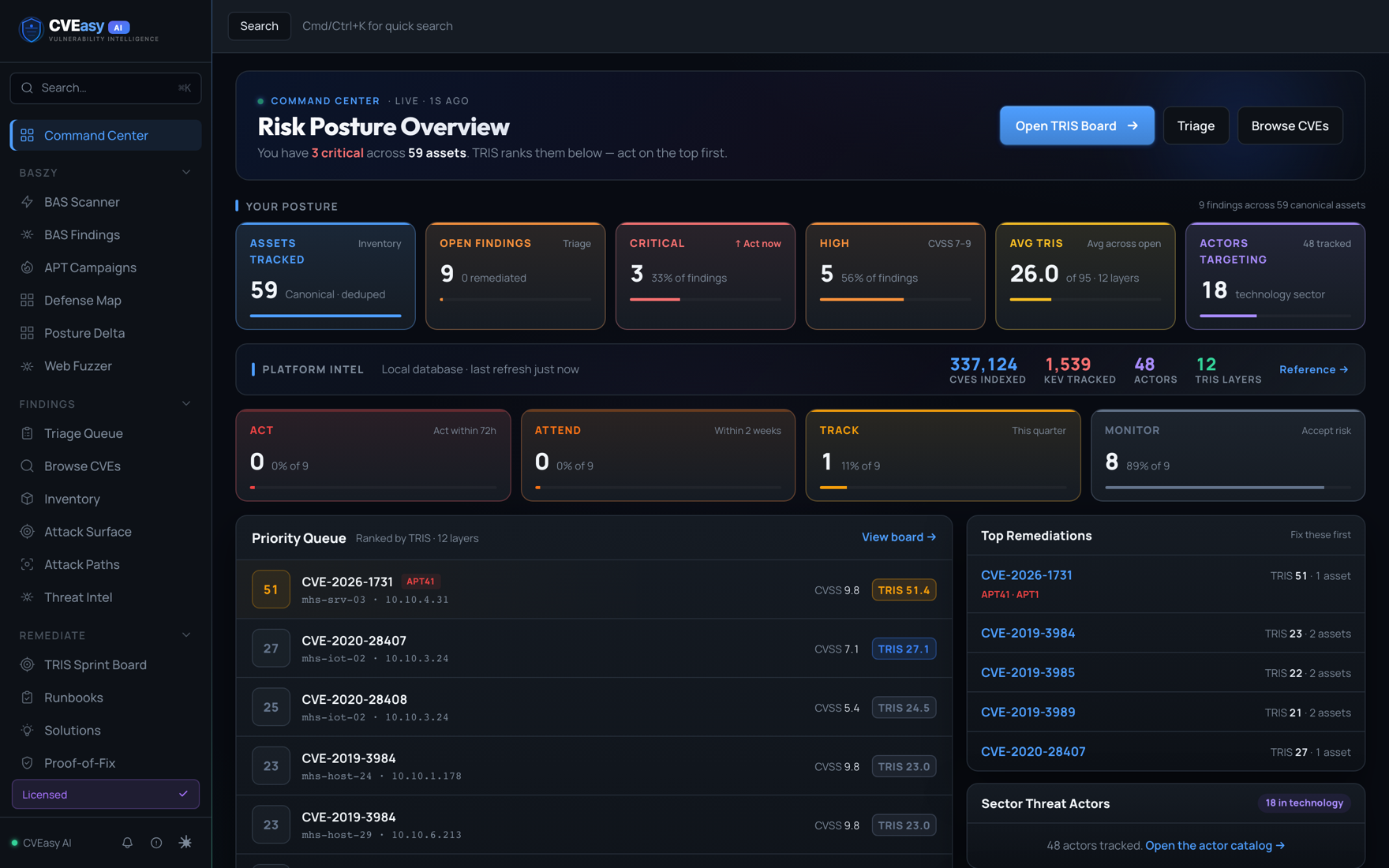
Everything you need to run a vulnerability management program, in one dashboard on one machine. The demo opens every module in the sidebar, down to the CVE detail page where each scoring factor shows its own arithmetic.
 CVEasyAILOCAL FIRST CTEM
You have 1,186 critical across 1,284 assets. TRIS ranks them below. Act on the top first.
CVE-2024-38077CVE-2025-0282CVE-2024-6387Every module in the sidebar opens. Command Center, CVE detail with the TRIS breakdown, Defense Map, campaign replay, Inventory, Threat Intel, the sprint board, the Proof-of-Fix ledger and the rest. One email opens it.
Paste a CVE and get a complete remediation runbook with OS-specific commands, verification steps, and rollback procedures, generated locally by your AI model in under 60 seconds.
Pull live from Rapid7, Tenable, Qualys, CrowdStrike, SentinelOne, and Defender on an auto-sync schedule, part of 158 integrations across 15 categories. TRIS scores everything automatically.
Every vulnerability scored 0 to 100 from exploitation likelihood, backtested against later CISA KEV additions, plus your asset context and any confirmed exploitation. Click to score any CVE yourself in our free TRIS Lab.
Trace exploitation chains across your infrastructure to see how vulnerabilities connect and which paths are most dangerous.
Executive narratives instead of spreadsheets: risk posture, trend analysis, and remediation progress in language the board understands.
CSPM and CIEM for AWS, Azure, and GCP from one place: 204 CIS-tagged checks with a per-framework compliance coverage rollup, built by CVEasy rather than resold. It runs against your own accounts, results stay in your local instance, and there is no per-asset cloud pricing.
CVEasy generates the OS-specific fix, then orchestrates it through the consoles you already run: Intune, Automox, Tanium, Jamf Pro, PDQ Connect, plus a webhook fallback. Fail-closed, encrypted credentials, and a closed-loop re-scan that confirms the fix. It drives your tooling, it does not push patches to endpoints itself.
158,271 attack payloads mapped to MITRE ATT&CK, integrated directly into your vulnerability management workflow: run breach simulations from the same platform that tracks your CVEs.
BASzy runs 158,271 MITRE ATT&CK-mapped payloads against your infrastructure, and when a control blocks the chain, the TRIS score comes down with the evidence attached. Click any node on the map for the finding behind it.
Findings are grouped by the fix that closes them, ranked by TRIS, and stamped with an SLA. From the same card you can push a patch through the tools you already run, schedule it into a maintenance window, or cut a ticket where your team already works. Every action is audit-logged and verified on the next sync.
The methodology of the previous model, with worked examples. TRIS 3 replaced it in release 1.7.4.
Threat intelFree feed, verified with ED25519 signatures, air-gap friendly.
ResearchAn open benchmark for attack-simulation coverage claims.
BlogThe newsletter and supply-chain radar, every week.
Published prices with one meter: a monthly or annual subscription sized by assets, from CVEasy Core at $49 a month, no per-user fees, no add-ons, and no cloud dependency. See every price or request a demo.
Includes BASzy attack simulation, AutoFuzz zero-day discovery, the Cloud Scan Engine (CSPM and CIEM for AWS, Azure, and GCP), detection rule export, SIEM integrations, posture scoring, ransomware readiness, and AI patch orchestration through Intune, Automox, Tanium, Jamf Pro, and PDQ Connect with exact commands.
Request a Demo See PricingNo per-asset fees; runs on macOS with Apple Silicon.
Set up in five minutes and keep your data on your hardware where it belongs.
Request a DemomacOS 13+ · 16 GB RAM · 2 GB disk