Turn the weekly vulnerability meeting into an exposure review that decides
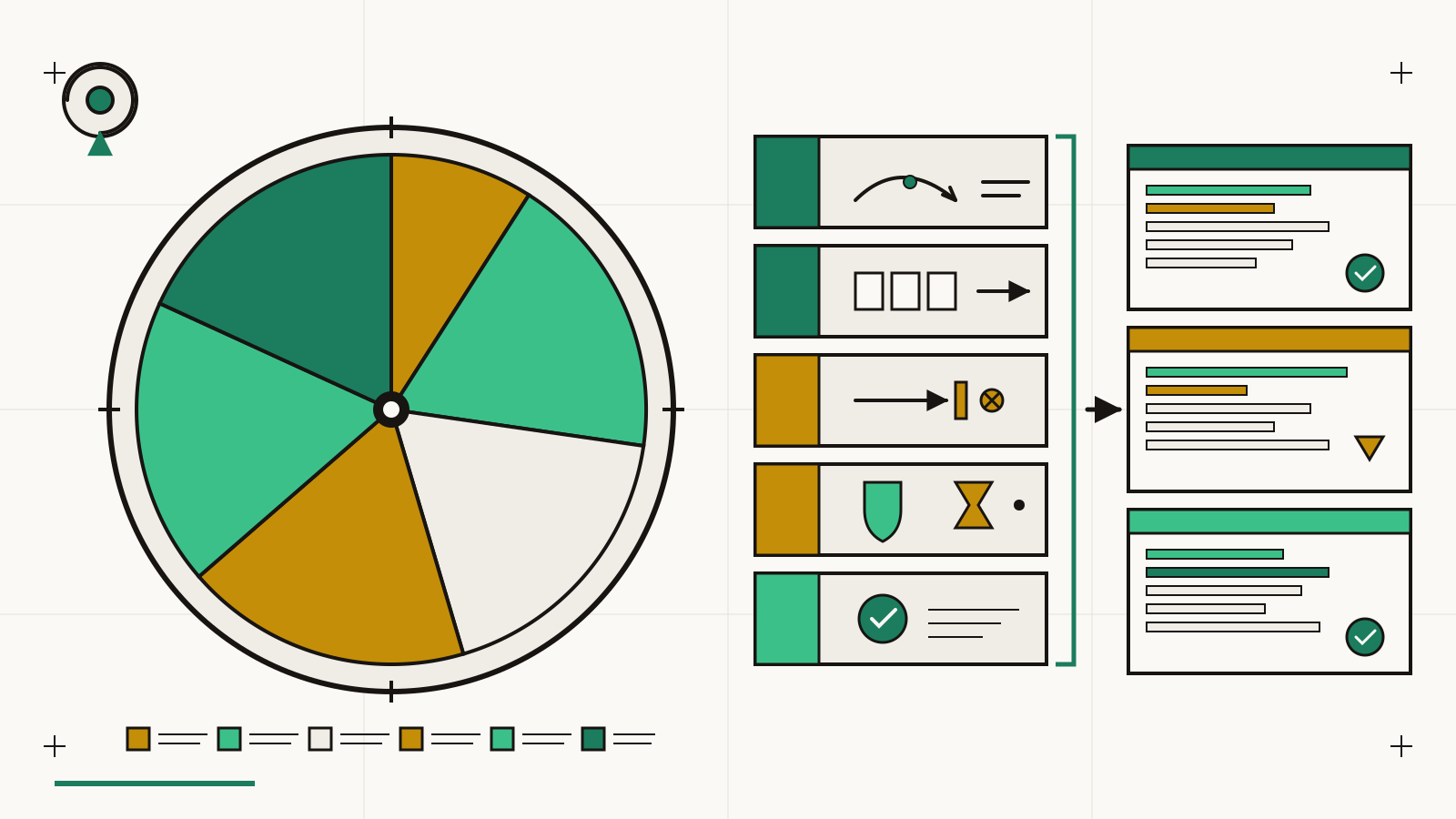
Most weekly vulnerability meetings share the same shape. Someone screen shares a dashboard, the severity totals get read aloud while a couple of tickets are reassigned in the chat, and someone else asks the same question about a scanner rule from last month before the meeting ends without a decision anyone could point to. The format was designed for monthly disclosures, quarterly remediation windows, and a review-the-list cadence that could survive drift because nothing else in the calendar cared. In August 2026 that program is a fiction three ways at once.
Three forces made the hour a control loop, not a status ritual
Federal remediation moves to tiered wall-clock deadlines on December 7, 2026 under BOD 26-04, and the four-variable risk answer (public exposure, KEV membership, exploit automatability, technical impact) has to be current per asset per finding. That is a weekly-cadence problem, and the meeting is where the answers actually change hands.
The EU Cyber Resilience Act reporting duty begins September 11, 2026 with a 24-hour early-warning clock that starts at awareness of active exploitation. The meeting where a team first notices exploitation is now the meeting where a legal timeline begins ticking, and the room needs the person who can activate the disclosure.
The third force is the room itself. Help Net Security's 2026 workforce report puts practitioner burnout at 76% over the past year, US analysts at 10.8 additional hours a week on average, and 70% of SOC analysts with five years or less of experience leaving within three years. A weekly meeting that reads a dashboard back to the people already carrying that load is a tax on the exact talent a program cannot afford to burn.
Two disciplines the meeting owes its design to
The mechanics for a good weekly review already exist outside security. The Google SRE production meeting (chapter 31 of the Site Reliability Engineering book) runs weekly at thirty to sixty minutes, with a rotating chair, a standing agenda, and one artifact: everyone leaves with the same picture of production. That is the closest published analog to what a weekly exposure review should be, and walking out with a shared operating picture rather than a shared status update is the piece most vulnerability programs never adopt.
The second borrow is architecture decision records, Michael Nygard's small dated files per architecture decision, later documented by Martin Fowler. The ADR community's own framing is that the collection of records is the decision log, and porting that discipline into risk-acceptance governance gives a program a record that outlives the meeting and answers the auditor's question years later.
What no security document ships is a weekly meeting FORMAT. The SANS vulnerability management policy template tells a program to review regularly without prescribing a format. NIST SP 800-40 Revision 4 reframed patching as preventive maintenance and dropped governance cadence entirely; the patch and vulnerability group concept from SP 800-40 Version 2.0 (2005) was retired by NIST two revisions ago. The cadence gap is real and the meeting design below is the fill-in.
Five questions the meeting exists to answer
If a room cannot answer these five in an hour, it is the wrong room, the wrong agenda, or both. Cancel it or redesign it; do not preserve it out of habit.
- What changed in our exposure this week?
- Which findings must be acted on before the next meeting?
- What is blocked, and by which owner?
- Which residual risks are we accepting, and under what expiration?
- What evidence proves last week's work reduced exposure?
Every question closes a real loop. One holds intelligence and inventory accountable for freshness, two forces the ACT queue to leave the room with owners assigned, three surfaces routing and change-management pain that shows up nowhere else, four is the exception governance the risk register depends on, and five is the receipt without which every past decision reverts to narration.
A fixed agenda in six time boxes
An hour, six segments, always the same order. Timing is a contract with the room, not a suggestion.
- 5 minutes. New ACT findings since last meeting.
- 10 minutes. Top exposure changes on the TRIS ranking (upward promotions and downward demotions).
- 10 minutes. Blocked remediation, one blocker per line, one owner per blocker.
- 10 minutes. Failed validation and reopened findings.
- 10 minutes. Exceptions expiring inside 30 days.
- 10 minutes. Decisions recorded and owner commitments confirmed.
Two design choices are worth defending. "Top exposure changes" is ranking movement between meetings, not a re-read of the same top ten; a finding that appears twice in a row does not deserve airtime the second week. And "decisions recorded" is its own segment, protected from the overrun that usually eats it. If the entries do not land in a written ledger before people leave, the meeting produced narration.
The pre-work brief, shipped 24 hours ahead
Nothing kills a decision meeting faster than doing discovery live. Security ships one email or shared page 24 hours before every meeting, with these fields and nothing else:
- Top ten exposures by TRIS score, with the delta since last week.
- New KEV matches, active exploitation matches, and Vulnrichment shifts on already-open findings.
- Findings with failed BAS validation, against a compensating control or a deployed patch.
- SLA breaches split by tier and by the three clocks the SLA clock post tracks: discovery to owner, owner to change, change to validated.
- Ownerless findings on the ACT or ATTEND queue.
- Exceptions expiring in the next 30 days, grouped by the four exception categories.
- Remediation completed and validated in the past week, each row linked to its evidence artifact.
Attendees read the brief before the meeting and arrive with a proposed decision on every item they own. The meeting picks among proposals; it never surfaces them for the first time.
The room, and who is not in it
Attendance is people who can decide, not people who can observe:
- Vulnerability program owner, chairing on a rotating basis per SRE discipline.
- Infrastructure lead.
- Application or platform lead.
- Cloud lead.
- Detection or SOC lead.
- Business owner representative, present for any item that touches a business-decision exception.
- Compliance or GRC lead, present when a CRA disclosure clock is on the table.
A team without a delegated decision maker in the room is a team that blocks the queue for another week. Spectators receive the decision log by email; they do not consume airtime.
The decision log, ADR-shaped
The log outlasts the slide deck by years, and its shape is the same for every entry. Each row is a small timestamped record with fixed fields:
- Finding or exposure reference (CVE, TRIS ID, or exposure path).
- Decision made (fix, defer, accept with control, close as false positive, escalate).
- Owner accepting the action, by name.
- Due date on a wall clock, not a sprint boundary.
- Accepted residual risk, if any, with an explicit expiration date.
- Validation requirement (rescan, BAS run, purple exercise, or none, with a reason for none).
- Exception category link if the decision writes an exception.
Two rules keep the log honest. First, no entry closes without a validation field; a decision that produces no evidence is a note. Second, no entry ships with "TBD" in the owner or expiration field; both are the first thing an auditor asks about, and both are the first thing that rots in a spreadsheet that nobody diffs.
The re-band slot at the top of exposure changes
Sitting at the head of the top-exposure-changes segment: a five-minute item on findings whose band changed since last week, and why. The SLA clock post lists the six re-band triggers (KEV addition, public exploit publication, reachability change, internet exposure change, ownership change, blast radius change), and this is the meeting where each trigger turns into a routed ticket with a fresh clock or a validated demotion carrying evidence. Skip the slot and the trigger dies in the ticket system while the queue reshapes underneath the program.
Anti-patterns to remove on day one
- Reading the whole dashboard. The dashboard is background reading; the meeting is decisions. If the pre-work brief did its job, the dashboard scroll is redundant.
- Treating every critical as equal. The band, the tier, and the clock all matter, and lumping them together is how the room ends up debating a two-week finding while an ACT ticket ages.
- Owner-less items surviving past the meeting. Every ownerless finding leaves with a routing owner and a target date to name the technical owner, or it escalates.
- Exceptions without expirations. This is the operating model failure that turns the risk register into fiction. The exception category dictates the expiration; the meeting enforces it.
- The loudest team redefining priority mid-meeting. The scoring model is the model, and the meeting protects it rather than overriding it without evidence written down.
- Skipping the log to save five minutes. The log is the meeting's product; every other segment is preparation for it.
The platform that carries the meeting
CVEasy AI carries the pre-work brief and the decision log inside the same local-first Continuous Threat Exposure Management platform that holds TRIS ranking and BAS validation, so the meeting reads from one source of truth and writes back into it during the same hour. The blog owns the meeting design; the tooling only makes it cheaper to run.