Top 10 CTEM Platforms Compared (2026)
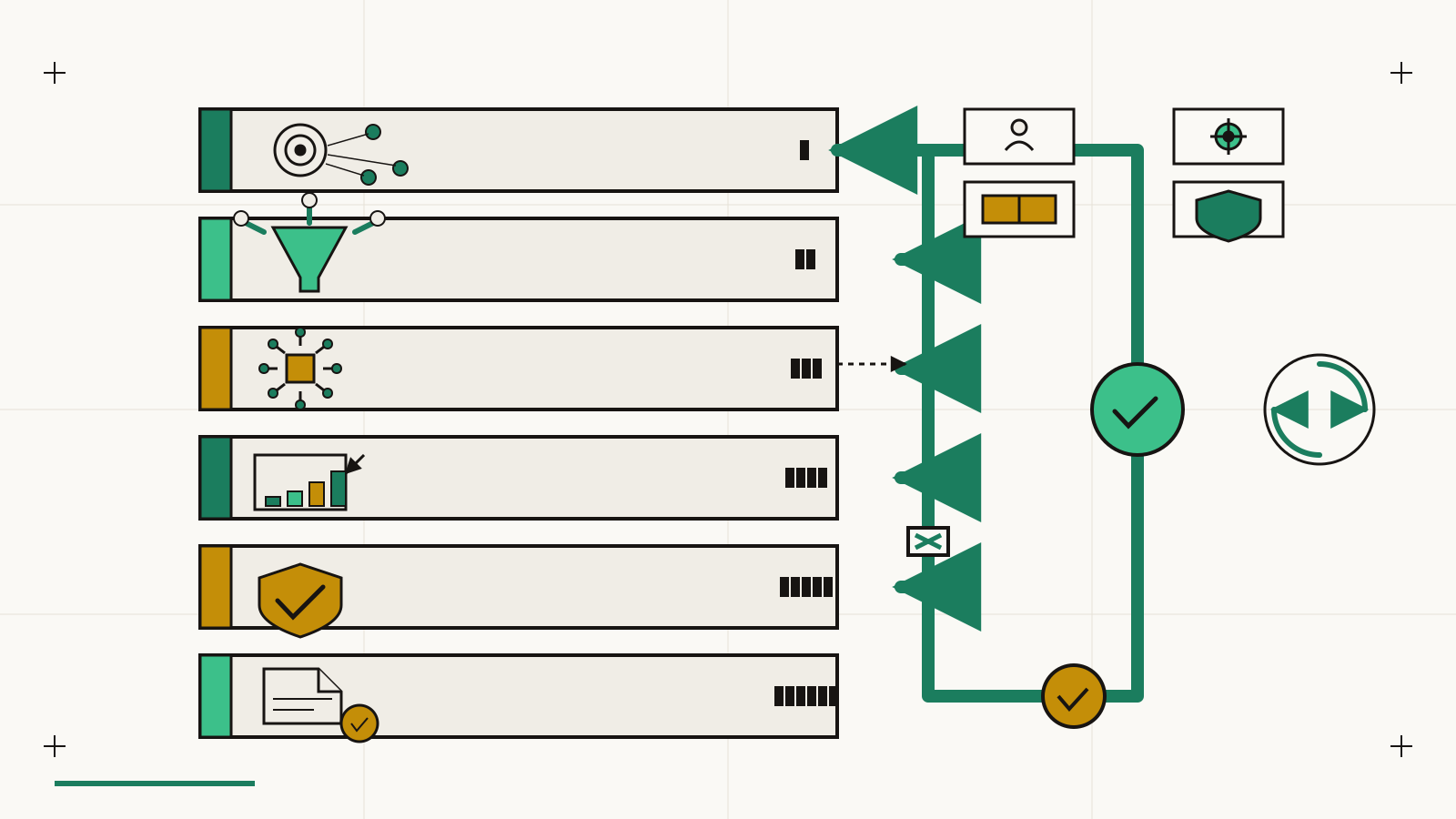
Gartner defined Continuous Threat Exposure Management in 2022 as a five stage program: scope, discover, prioritize, validate, mobilize. Four years later, nearly every security vendor claims the CTEM label. Most earn it for one or two stages and market the rest.
This guide compares the ten platforms practitioners actually shortlist for CTEM in 2026. The test we apply to each: which of the five stages does it genuinely run, does it prove exploitability or just predict it, where does your exposure data live, and what does the pricing do as your asset count grows. We have tried to be fair to every vendor on this list, including ourselves.
What counts as a CTEM platform
Vulnerability scanners rebranding as CTEM is the defining marketing move of this cycle, so it helps to hold a hard line on definitions. A real CTEM platform needs:
- Unified exposure management: One place where findings from every source (network scanners, cloud posture, endpoint, identity) get deduplicated onto a single asset graph and ranked in one queue. Four consoles with four severity scales is the problem, not the program.
- Prioritization beyond CVSS: Exploit prediction, active exploitation evidence, asset criticality, business impact, and reachability. A CVSS 9.8 on an isolated dev box should rank below a CVSS 7.2 on your payment gateway.
- Validation: Stage 4 is where most platforms quietly stop. Attack simulation or automated pentesting that proves an exposure is exploitable before it consumes remediation budget.
- Closed-loop mobilization: Owners, fix steps, SLA tracking, and re-validation that the fix landed. A prioritized list is not a program.
- A deployment model you can live with: Most CTEM platforms are SaaS, which means your complete exposure map (every asset, every weakness, every attack path) lives on someone else's infrastructure. For some organizations that is fine. For regulated, defense, and air-gapped environments it is disqualifying.
The comparison table
| Platform | CTEM stages covered | Validation method | Deployment | Pricing model |
|---|---|---|---|---|
| Tenable One | Scope, Discover, Prioritize | None built in | Cloud + on-prem scanners | Per-asset |
| XM Cyber | Discover, Prioritize, Validate | Attack-path simulation | Cloud SaaS | Per-entity, quote |
| Pentera | Validate (deep), partial Discover | Real automated exploitation | On-prem + SaaS | Per-scope, quote |
| Cymulate | Prioritize, Validate | BAS + control validation | Cloud SaaS | Modular, quote |
| Picus Security | Prioritize, Validate | BAS + detection validation | Cloud SaaS | Modular, quote |
| CrowdStrike Falcon Exposure Mgmt | Discover, Prioritize | None built in | Cloud (Falcon agent) | Per-endpoint, bundled |
| Microsoft Security Exposure Mgmt | Discover, Prioritize | None built in | Cloud (Defender-native) | Bundled with E5/Defender |
| Rapid7 Exposure Command | Scope, Discover, Prioritize | Metasploit adjacent, not integrated | Cloud SaaS | Per-asset |
| Qualys ETM | Discover, Prioritize | None built in | Cloud SaaS | Per-asset, tiered |
| CVEasy AI | All five | BASzy attack simulation built in | Local-first, air-gap capable | Flat-rate, no per-asset fees |
1. Tenable One
Tenable One is the market's default shortlist entry, built on the deepest detection library in the industry (Nessus) and extended with cloud posture, web app scanning, identity exposure, and external attack surface management. Its exposure view and VPR prioritization are mature and its compliance reporting is the best in class.
The honest gap is validation. Tenable One tells you what is theoretically exploitable based on threat intelligence; it does not run attacks to prove it. Pair it with a BAS or automated pentest tool and you have four stages covered, at two vendors' prices. Per-asset pricing also compounds as your discovery improves, which punishes you for doing stage 2 well. We wrote a direct comparison if Tenable is your incumbent.
Best for: Large enterprises that want maximum detection coverage and accept assembling validation separately.
2. XM Cyber
XM Cyber attacks the problem from the attack-path angle: it continuously simulates attacker movement across your hybrid environment and shows which exposures actually chain to critical assets. Its "choke point" analysis (the small set of fixes that sever the most attack paths) is genuinely useful and its safe-for-production simulation is well engineered.
It is the strongest pure exposure-path product on this list, but it assumes your scanner estate stays in place for discovery, and remediation workflow is thinner than the analysis layer. SaaS-only, so your full attack graph lives with the vendor.
Best for: Enterprises with mature scanning that want to know which of 40,000 findings actually reach crown jewels.
3. Pentera
Pentera runs real exploitation against your production environment: credential attacks, lateral movement, ransomware emulation, the actual kill chain. Of everything on this list it produces the least arguable evidence, because the finding is "we did it," not "a model thinks it is likely."
It is a validation engine, not a full program. Discovery is scoped to what its attacks touch, there is no CVE-database-wide prioritization layer, and mobilization is a report. Most Pentera customers run it alongside a separate VM platform. Pricing is quote-based and sized to scope.
Best for: Teams whose leadership needs proof, not scores, and that already run a full VM stack for the other stages.
4. Cymulate
Cymulate built its name in breach and attack simulation and has expanded toward exposure analytics. It tests your controls (email gateway, EDR, WAF, DLP) against current attack techniques, maps results to MITRE ATT&CK, and its immediate-threats feed lets you test yesterday's headline TTP against your own defenses within hours.
Control validation is not the same as exposure validation: Cymulate tells you whether your EDR catches technique X, less about whether CVE-2026-XXXX on server Y is reachable. Discovery and asset management depend on your existing stack. See our note on where BAS fits in a CTEM program.
Best for: SOC-heavy organizations that want continuous proof their detection and prevention stack works.
5. Picus Security
Picus pioneered the BAS category and remains the most detection-engineering-friendly option: every failed simulation ships with the vendor-specific detection rule to fix it, which SOC teams love. Its exposure validation module now scores vulnerabilities by whether related attack techniques succeeded in your environment.
Like Cymulate, it is stages 3 and 4 of the loop, strongest on the control side, and assumes the rest of your stack handles discovery and mobilization.
Best for: Detection engineering teams that want simulation results to convert directly into SIEM/EDR rules.
6. CrowdStrike Falcon Exposure Management
If the Falcon agent is already on every endpoint, Falcon Exposure Management gives you vulnerability assessment, external attack surface mapping, and ExPRT.AI prioritization with zero additional deployment. The telemetry advantage is real: it sees what is running, where scanners only see what is installed.
Coverage follows the agent, so network devices, unmanaged assets, and anything agentless are blind spots. No built-in validation. It is an excellent module inside the CrowdStrike ecosystem rather than a standalone CTEM program.
Best for: Committed CrowdStrike shops that want exposure visibility without another deployment project.
7. Microsoft Security Exposure Management
Microsoft's entry aggregates signal from the Defender family into attack paths and "initiatives" (curated exposure programs for ransomware, identity, and cloud). For E5 estates it is effectively included, which makes it the cheapest way to start thinking in attack paths rather than CVE lists.
It is Azure-and-Defender-shaped: hybrid and non-Microsoft coverage is limited, prioritization is opaque, and there is no exploit validation. Treat it as a strong free baseline inside the Microsoft wall, not the program itself.
Best for: Microsoft-first organizations that want attack-path context from licensing they already own.
8. Rapid7 Exposure Command
Exposure Command unifies Rapid7's InsightVM, cloud security, and external ASM into one exposure console with attack-path analysis. For existing Rapid7 customers it is a meaningful upgrade over flat InsightVM dashboards, and Rapid7's research arm (Metasploit, AttackerKB) feeds real exploitability data into prioritization.
Metasploit expertise notwithstanding, integrated automated validation is not part of the product, and per-asset pricing applies. We work with Rapid7 environments constantly; our MSSP clients typically keep InsightVM for scanning and layer scoring and validation on top.
Best for: Rapid7 incumbents consolidating VM, cloud, and ASM views into one console.
9. Qualys Enterprise TruRisk Management
Qualys ETM extends TruRisk scoring across Qualys and third-party findings, adding an aggregation layer that accepts external scanner data, which pushes it toward genuine unified exposure management. De-risking factors like compensating controls feed the score, and the compliance pedigree is strong.
The platform still carries Qualys's module-based pricing complexity, the UI shows its age, and validation is absent. Our Qualys comparison covers the details.
Best for: Existing Qualys estates that want one risk score across mixed scanner sources.
10. CVEasy AI
CVEasy AI is the only platform on this list that runs all five CTEM stages in one application, and the only one that is local-first: it runs on your hardware, works fully air-gapped, and your exposure map never leaves your building.
It is unified exposure management by construction. Findings from 158 integrations across 15 categories (Nessus, Qualys, Rapid7, cloud posture, endpoint, identity) are deduplicated onto one asset and attack-path graph. TRIS v2 12-layer scoring (Patent Pending) ranks them by exploit prediction, active exploitation, threat actor targeting, asset criticality, reachability, and financial impact. BASzy attack simulation validates exploitability with 158,271 payloads mapped to MITRE ATT&CK, and built-in AI remediation drives fixes to verified closure. Flat-rate published pricing, no per-asset fees.
Limitations
- Local-first means you host it: your hardware, your updates
- Younger platform and smaller community than the incumbents above
- No managed SaaS for teams that want the vendor to run everything
Best for: Organizations that want the full CTEM loop in one tool, regulated and air-gapped environments that cannot ship exposure data to a SaaS vendor, and anyone tired of per-asset pricing that grows every time discovery improves.
How to choose: three questions that settle it
1. Where must your exposure data live? If the answer is "on our infrastructure," the list shrinks to Pentera's on-prem option and CVEasy. Everything else ships your complete attack surface to a vendor cloud.
2. Do you need proof or prediction? Tenable, Qualys, Rapid7, CrowdStrike, and Microsoft predict exploitability from threat intelligence. XM Cyber, Pentera, Cymulate, Picus, and CVEasy demonstrate it. If your remediation queue is contested (and it always is), demonstrated beats predicted in every argument with IT.
3. One platform or a stack? A common enterprise pattern is scanner + exposure analytics + BAS: three contracts, three consoles, three renewal cycles. It works, and it costs roughly triple. The consolidation question is whether one platform's coverage of all five stages is deep enough for your environment. That is the exact evaluation we built the eight-question CTEM buyer's framework for, and a demo against your own scan data answers it faster than any comparison post.