Patch Everything Is Dead: AI Teams Are Shipping Software They Cannot Secure
Something changed in the last eighteen months, and most security teams felt it before they could name it. The volume of software supply-chain attacks did not creep upward. It jumped. Poisoned packages, hijacked maintainer accounts, leaked continuous integration tokens, and trojanized build steps stopped being rare headline events and started looking like a steady operating condition.
The reason is not mysterious. It is structural, and it traces back to a single shift: AI handed production-grade build and integration capability to an enormous number of teams who do not know how to secure what they ship.
Why the Wave Is Surging Right Now
Two years ago, wiring a language model, an agent, or a retrieval pipeline into a production system was specialist work. Today it is a weekend. AI assistants generate the glue code, pull in the dependencies, and stand up the integrations. That is a genuine gift to builders, and it is also the problem.
Every one of those new integrations expands the dependency graph and the trust surface. Each agent that calls out to a tool, each model endpoint, each freshly added package brings its own transitive baggage. Teams are now shipping software whose full composition they cannot describe, on timelines that leave no room for the slow work of security hardening. Capability raced ahead. Security maturity did not keep pace.
Attackers read this clearly. The hardened perimeter, the firewall, the authenticated edge, those are expensive to break. The build and dependency layer is soft. A single compromised package or a leaked token in a pipeline reaches straight past the perimeter and lands inside the room where code is assembled and trusted. We have widely documented proof that this layer is a viable target: the xz utils backdoor was the product of a multi-year campaign to win a maintainer's trust, and Log4Shell showed how one buried dependency can put millions of systems at risk overnight. The underbelly is the build, not the wall.
The Core Skill Gap Is Context
Here is the part most teams get wrong, and it is the part AI was supposed to fix. They have the models now. Claude, OpenAI's models, a growing roster of agents, all sitting right there in the workflow. So they do the obvious thing. They dump a raw CVE list into the prompt and ask the model to sort it out.
They get noise back, because they fed it noise. A list of two thousand findings ranked by severity score is not context. It is a spreadsheet with a chat interface. The model has no idea which of those assets actually runs your revenue, which finding is reachable from the internet, which one carries blast radius into your crown jewels, and which one is a theoretical issue on a host nobody can touch.
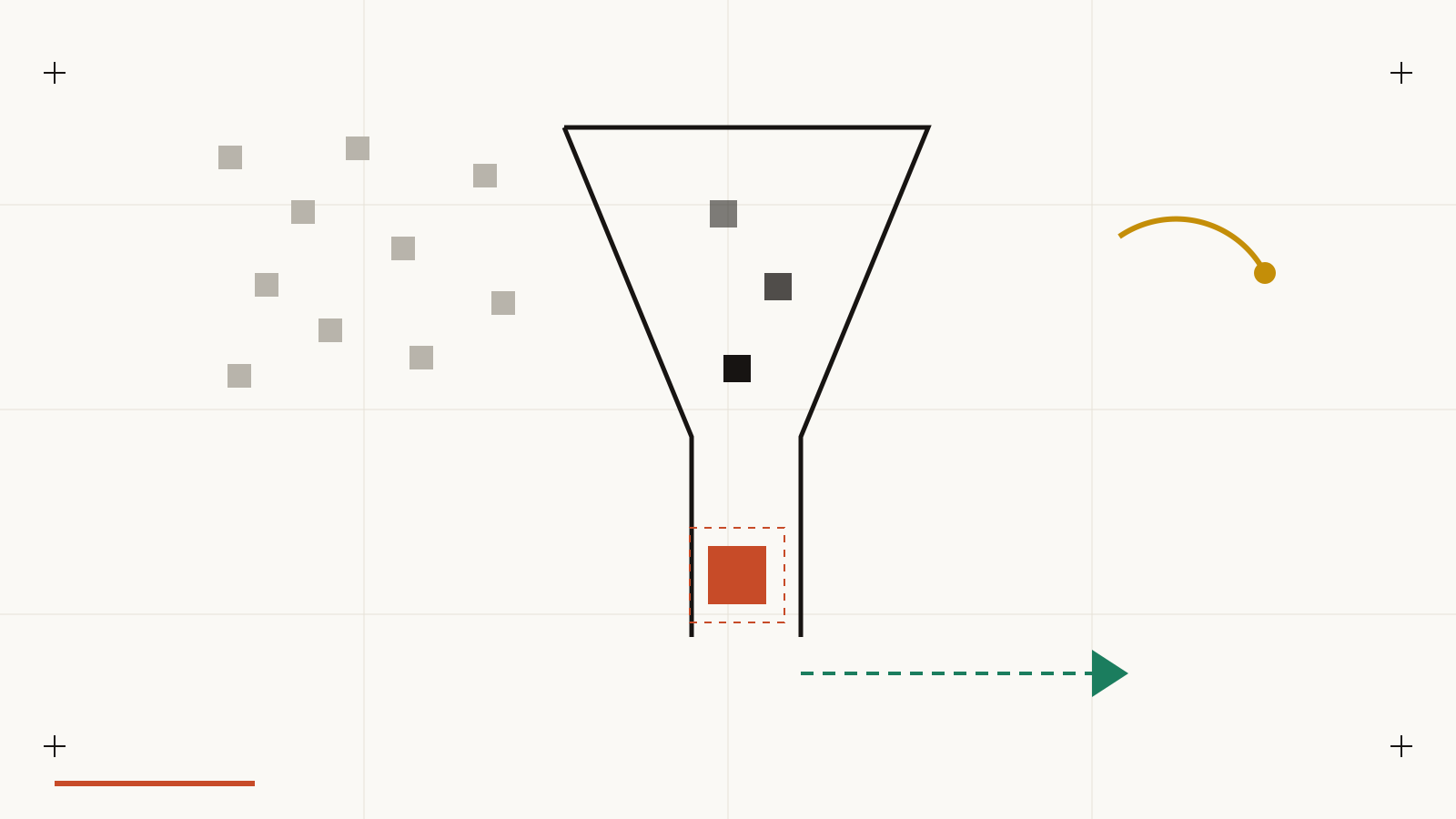
The skill that separates teams who get value from AI from teams who get a faster way to generate noise is context engineering. Grounding the model in prioritized exposure rather than raw data. Compare the two inputs side by side.
Good context is built from a small number of high-signal layers: asset criticality, active-exploitation and known-exploited signals, reachability, and concrete business impact. Feed those in and the model becomes a force multiplier. Skip them and you have automated the production of the very backlog you were trying to escape. Context engineering for security is becoming a core competency, and the teams who treat it that way are pulling away from the ones who do not.
From Patch Everything to Patch What Matters
The strategy underneath all of this has to change too. "Patch everything" was always a fiction. It never scaled, and in an AI-accelerated world it is actively harmful, because the rate of new findings now outpaces any human team's capacity to triage them by hand. Patch everything buries people. It turns security into a treadmill that runs faster every quarter.
The workable model is to patch what you should actively care about. Prioritization by real risk is not a nice-to-have efficiency gain. It is the only posture that survives contact with the volume modern teams face. The question stopped being "is this vulnerable" and became "is this exploitable, reachable, and consequential in this environment."
This is exactly what TRIS, the multi-layer Threat and Risk Intelligence Scoring engine inside CVEasy AI, was built to answer. TRIS weighs active exploitation, blast radius, reachability, and genuine exposure rather than treating a raw severity number as the final word. A textbook severity score in isolation tells you how bad a flaw could be in the worst imaginable deployment. TRIS tells you what it means on the asset you actually run. That difference is the line between a queue your team can clear and one that clears your team.
Defense in Depth for the AI Era
Even with perfect prioritization, you have to plan for the foothold you will not catch. Assume it happens. A poisoned dependency slips through. A continuous integration token leaks. An agent gets talked into something it should not have done. In an environment where the build layer is this exposed, treating initial compromise as a possibility rather than a certainty is wishful thinking.
So the discipline shifts from preventing the first landing to limiting what an attacker can do once they have it. The team at BlueTeamAutomation calls that first internal landing spot the pivot point, and the name is apt, because everything an adversary does after that moment is a pivot toward something more valuable. The goal of layered defense is to make those pivots expensive, slow, and loud.
- Scope build credentials tightly so a single leaked token unlocks one job, not the whole pipeline.
- Segment environments so a compromised build step cannot reach production secrets or lateral targets unchallenged.
- Constrain what agents and service accounts can call, and log every step so a pivot leaves a trail.
- Treat reachability as a first-class control, because an asset an attacker cannot route to is one they cannot pivot from.
One compromised build step should never become full environment compromise. Defense in depth is how you guarantee that the first foothold is also close to the last move an attacker gets to make.
Where the Industry Is Heading
Put these threads together and the direction is clear. Scan and patch, the workflow that defined vulnerability management for two decades, is giving way to Continuous Threat Exposure Management. CTEM is exposure-driven by design. It asks what is genuinely reachable and consequential, monitors it continuously rather than on a monthly cadence, and grounds decisions in real intelligence rather than raw counts.
AI belongs at the center of that shift, but only when it is fed the right context. A model grounded in prioritized exposure is a decisioning engine. A model fed a CVE dump is a noise amplifier. The teams who understand the distinction will spend the next few years operating calmly while the rest keep sprinting on the patch-everything treadmill.
CVEasy AI is the local-first CTEM platform built for this moment, with TRIS as the prioritization engine and your sensitive vulnerability and asset data staying on your own hardware instead of being shipped to a third party. That last detail matters more every month, because the context that makes AI useful for security is precisely the context you least want leaving your network. Patch everything is dead. What replaces it is sharper, quieter, and finally something a team can actually sustain.