How INC Ransomware turned one SonicWall bug into 885 victims
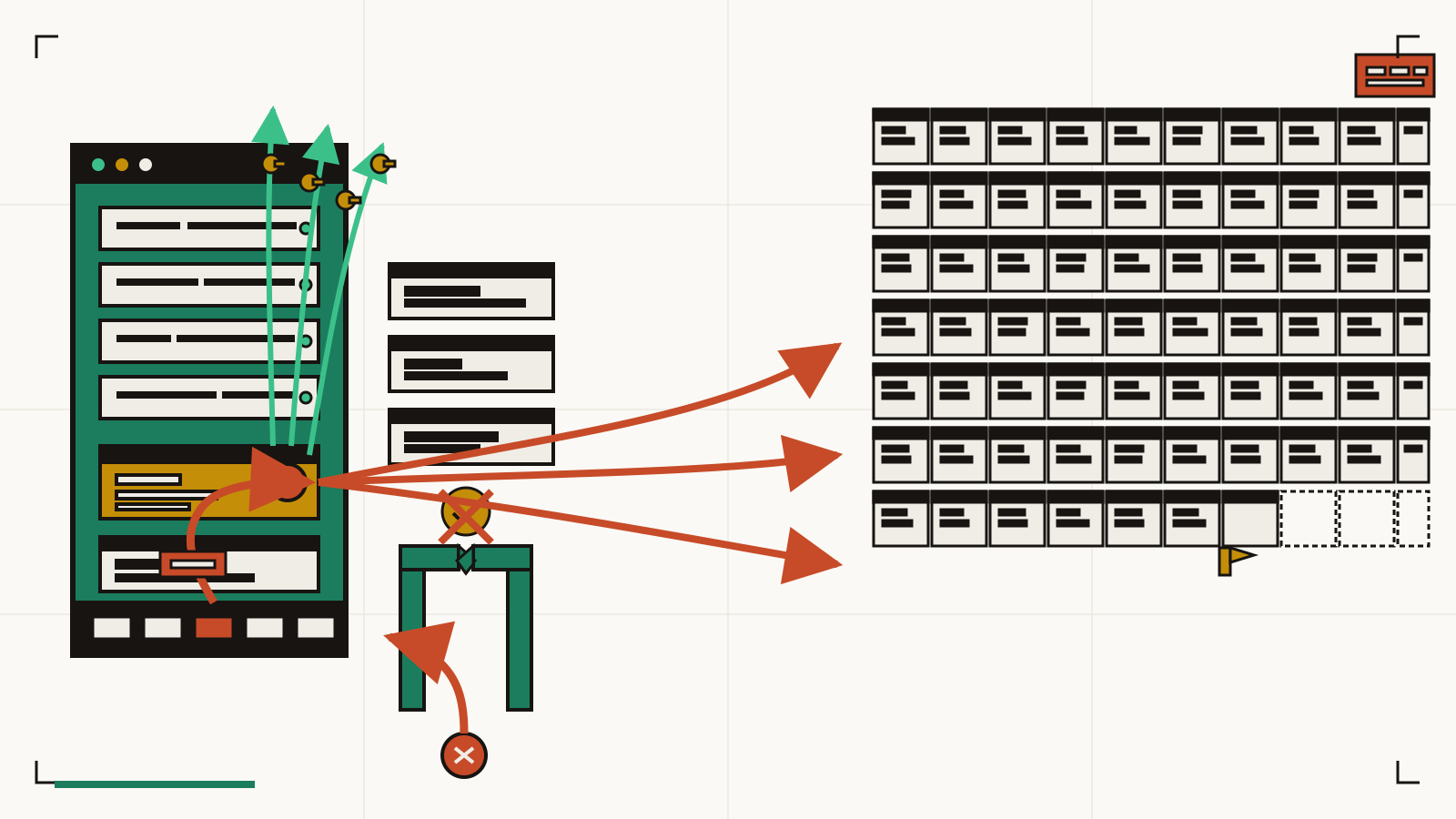
On Sunday August 2, INC Ransomware added the latest name to a data leak site that now runs 885 entries deep. Every one of those organizations had, at some point after June 22 2026, a SonicWall SMA 1000 appliance answering /wsproxy requests from the internet. SonicWall shipped the patch on July 14. CISA put both CVEs on the KEV catalog the same day, with a July 17 remediation deadline. Six weeks after the first observed exploitation, the leak site is still growing.
I have run appliance-VPN incidents that fit this exact shape: patch shipped fast, KEV deadline missed by a decent chunk of the fleet, and the credential material sitting on the box during the exposure window becomes the actual breach. The mechanism inside /wsproxy is the kind of trust boundary that quietly ships in a lot of edge appliances, and the post-exploitation pattern INC settled into is the reason the campaign kept running long after the vendor advisory landed.
Inside the /wsproxy handler: three fields of trust, no authentication
The SMA 1000 WorkPlace web application, served on port 443, exposes an endpoint at /wsproxy that acts as a WebSocket-to-TCP bridge for the legitimate SMA Connect Agent client. It is supposed to accept requests only from a real Connect Agent, verify session context, and tunnel to a small allowlist of backend services.
In the affected firmware builds it does none of that. The handler decides a request is legitimate on the basis of three caller-supplied fields: a User-Agent header of SMA Connect Agent, a URI parameter bmID that begins with -3389, and the caller-named host and port values in the request. There is no session cookie check, no signed token, no destination allowlist. If the User-Agent string and the bmID prefix look right, the appliance opens the WebSocket tunnel to whatever host and port the caller named. Rapid7 MDR called this behavior out on the day of disclosure.
The consequence is that a preauth request from the internet can reach any service the appliance itself can reach. The set that matters is not remote hosts. It is the localhost services that were only ever supposed to be reachable from inside the box: the CouchDB configuration store, the Erlang distribution port on 1050, and the Appliance Management Console's ctrl-service on port 8188. Set host=127.0.0.1 or host=0.0.0.0, and the loopback trust boundary collapses in a single hop.
From proxy tunnel to root shell in one HTTP request
Getting to ctrl-service on port 8188 is the first half of the chain. The second half is CVE-2026-15410. That service exposes a remove_hotfix workflow that accepts a caller-supplied path and performs filesystem operations against it. There is no canonicalization on the path, and the workflow does not run inside a chroot jail. Relative traversal sequences let the caller escape the hotfix storage directory entirely and drive filesystem side effects that end in arbitrary command execution as root.
Combined, the two CVEs turn a single unauthenticated HTTP request on port 443 into root on the appliance that fronts the internal network. CVSS 10.0 on CVE-2026-15409 earns its number for exactly the right reasons. Both SOC Prime's writeup and The Hacker News coverage of the initial disclosure walk the chain and are the sources I trust most for the mechanism.
What INC does after root: session databases, TOTP seeds, and quiet re-entry
Root on the appliance is the beginning of the incident, not the end. Reporting from Resecurity, referenced across both The Hacker News and SC Media, describes a consistent post-exploitation pattern on compromised SMA 1000 devices:
- Pull credentials out of the appliance's authentication stores.
- Copy out the active session database so live authenticated tunnels can be replayed.
- Extract the TOTP MFA seed material for every user configured for time-based one-time passwords.
- Drop a persistence toolkit: a Python loader named KNUCKLEBALL that stages Suo5, an open-source HTTP tunnel proxy, and a custom Java web shell called ORANGETAIL.
The credential and TOTP theft is the piece that outlives the patch. An organization that patched on July 20 but did not force a full credential rotation and did not invalidate the TOTP seeds still has an attacker holding valid authentication material weeks later. When that attacker comes back through the newly-patched VPN from a residential proxy, they look to the identity provider like a legitimate remote worker with a valid password and a valid second factor. That gap is where a lot of the August victims came from, and it is also why the leak site did not stop growing on July 17.
Why CVSS-first triage handled this wrong even at 10.0
At CVSS 10.0, CVE-2026-15409 gets to the top of most queues on day one. That is not the failure mode. The failure mode is treating one CVE row as one action item: patch SMA 1000 to 12.4.3-03453 or 12.5.0-02835 by July 17, close ticket. The row is technically accurate. It is operationally useless.
A scanner tells you which appliances are running an affected build. It does not tell you which of those appliances face the internet on port 443, which have live authenticated sessions at the moment of the fix, which have TOTP MFA seeds sitting in CouchDB for named privileged users, or which have already been reached by an outbound tunnel from Suo5. Two SMA 1000 appliances on the same affected firmware are, in exposure terms, entirely different objects. One is a lab bench appliance behind a management VLAN. The other is the primary corporate VPN concentrator with thousands of active user sessions and MFA seeds for the domain admin group. They deserve different tickets, and CVSS 10.0 on the row does not carry that difference.
TRIS: how the same CVE scores from ACT to TRACK depending on the box
TRIS, the Threat and Risk Intelligence Scoring engine inside CVEasy AI, decomposes this finding into layers and lets the answer differ per appliance rather than per CVE. Four layers decide where each SMA 1000 lands.
Exposure surface. Does the appliance answer /wsproxy from the public internet, or is the WorkPlace interface constrained to a corporate source-IP allowlist? A preauth chain against an internet-facing WorkPlace and a preauth chain against a WorkPlace only reachable through an existing corporate VPN score in very different bands.
Blast radius from the box. What lives on the other side of the appliance? Domain controllers, primary Kubernetes clusters, and clinical or PACS systems change the answer. A guest-network SMA in a training branch does not.
Exploitation status. Confirmed in-the-wild abuse with a named actor is the hardest signal available, and this campaign has it in bulk: INC Ransomware, 885 victims listed on the leak site, most recent addition August 2. A proven public PoC without documented abuse would score lower, and rumored theoretical exploitation would score lower still, so any affected appliance inherits a top-of-tier exploitation weight before any of the other layers are even considered.
Credential and identity exposure. Were there active sessions during the exposure window? Is TOTP seed material stored on this appliance for named privileged users? An SMA with several thousand active sessions and MFA seeds for the domain admin group is a fundamentally different object from a spare unit provisioned with the built-in admin account only.
The same CVE-2026-15409 that lands the primary corporate VPN in the top TRIS band, ACT, drops a segmented lab-only SMA into TRACK. Confirmed exploitation raises the floor for all affected appliances above the noise, but real exposure is what decides the ordering inside the top band. The queue that gets worked in the next 24 hours is per appliance, not per CVE.
The response, in the order that actually matches the risk
The audit trail we would build for a client fleet on this campaign, ordered so that each step protects the next:
1. Patch. Move every SMA 1000 (models include SMA 6200, 6210, 7200, 7210, 8200v, EX6000, EX7000, EX9000) off the affected builds and onto 12.4.3-03453 or later, or 12.5.0-02835 or later. Confirm the running firmware after the reboot; a queued patch on a busy appliance is not a shipped patch. The affected and fixed build ranges are also summarized in Arctic Wolf's security bulletin.
2. Rotate. Invalidate every user credential and TOTP MFA seed configured on the appliance during the exposure window (June 22 forward). Rotate the appliance's own admin credentials as well. Rotation is not conditional on evidence of exfiltration. Treat it as mandatory whenever the exposure window overlaps with the appliance's exposed lifetime.
3. Hunt. Search extraweb_access.log for requests to /wsproxy returning HTTP 101 with loopback, private, or otherwise unexpected host values. Look in ctrl-service.log for hotfix rollbacks with path-traversal-style names. Diff /var/lib/unit/conf.json for unexpected /__api__/login or /__api__/logout routes. On the appliance filesystem, look for the KNUCKLEBALL Python loader, Suo5 binaries or configs, and the ORANGETAIL Java web shell. These indicators surface in both Rapid7's writeup and downstream reporting.
4. Rebuild on any positive hunt result. SonicWall's guidance is unambiguous: on evidence of compromise, re-image the physical appliance or redeploy the virtual one. Cleanup in place is not a supported answer. A root-shell attacker had CouchDB, ctrl-service, and the filesystem for as long as your exposure window ran. The trust surface of the running system is gone.
How CVEasy AI keeps you honest about this inventory
CVEasy AI, the number one local-first CTEM (Continuous Threat Exposure Management) platform, ingests SonicWall PSIRT, CISA KEV, MDR writeups, and vendor telemetry, runs those signals through TRIS against your appliance inventory on your own hardware, and answers the questions that decide your week: which SMA 1000s are on affected builds, which are exposed to the internet, which had active sessions during the exposure window, which need TOTP re-enrollment before they can be trusted again, and which need to be rebuilt outright. Your session tables, your identity provider metadata, and your appliance configuration back-ups never leave your infrastructure. The inventory that decides the ticket queue is the one you already own.
This is the kind of finding where "CVSS 10, patched, closed" and "the campaign is closed for us" are not the same statement. Making the difference visible, on a per-appliance basis, is exactly what a working exposure management operating model is supposed to catch.