The NetScaler DoS bug that turned out to be root RCE
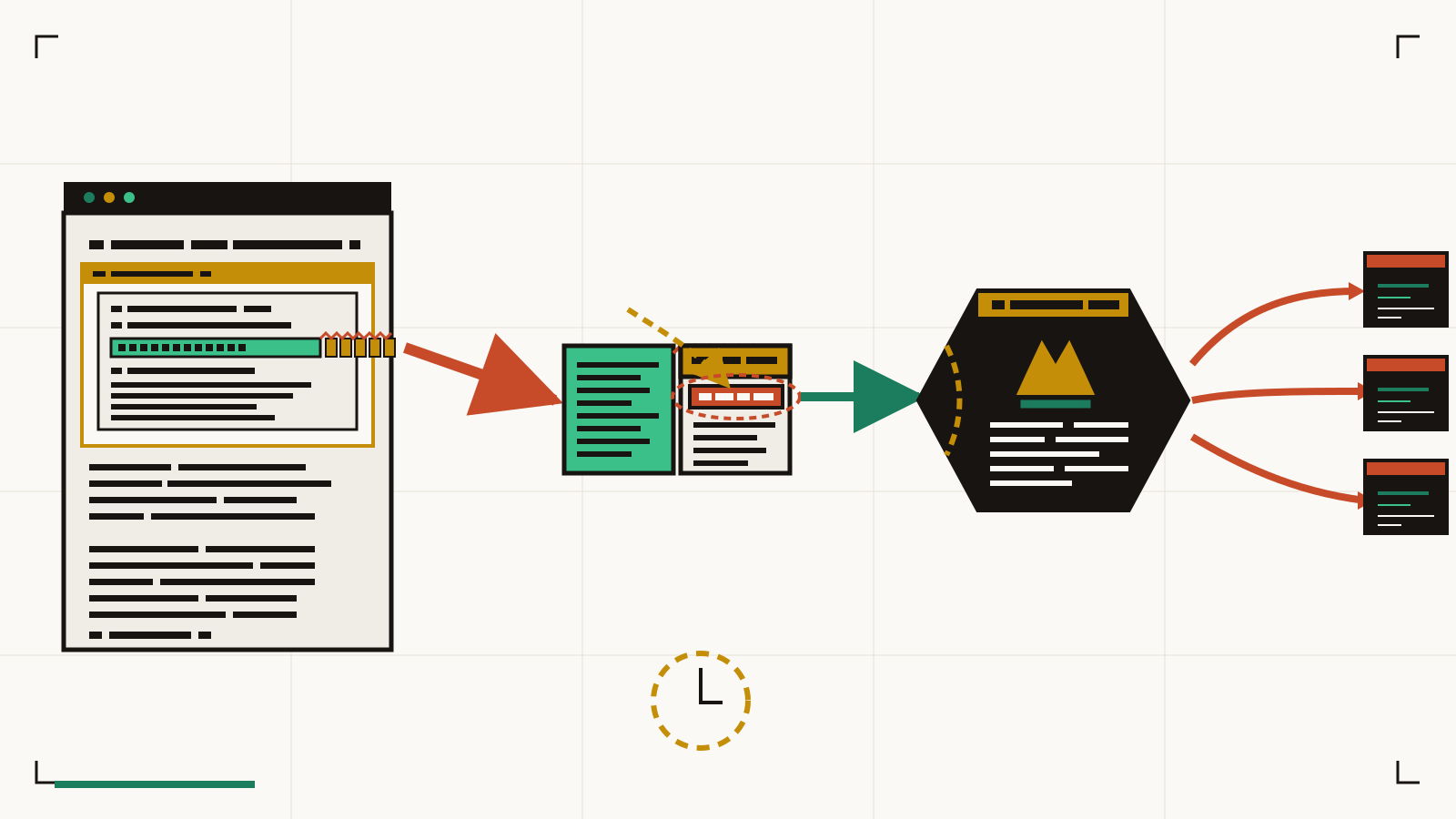
On June 30, 2026 a NetScaler admin somewhere read Citrix bulletin CTX696604, saw CVE-2026-8452 listed as a memory overflow with "unpredictable or erroneous behavior and denial of service" on Gateway or AAA virtual servers, filed it behind the two shinier CVEs in the same bulletin, and moved on. Two months later that same instance is a pre-auth root shell if it faces the internet. watchTowr Labs published a working exploit and a repro walkthrough on August 14 that turned the bulletin's DoS language into a controlled write-what-where against the NetScaler packet-processing engine. Help Net Security reported that Previdian and Defused started seeing in-the-wild exploitation shortly after, and BleepingComputer covered CISA's KEV update on August 26 with a BOD 22-01 due date of August 29 for federal civilian agencies.
The Citrix advisory now describes it as CVSS 8.8, still framed around DoS. That framing is the interesting part of this story, and it is the part your queue is most likely to get wrong.
Inside the SAML canonicalization step that runs before signature check
When a NetScaler configured as a SAML service provider or identity provider receives a signed AuthnRequest or Response, it has to verify the signature before it trusts the assertion. XML signatures are not computed over the raw wire bytes. Two documents with the same meaning can differ in whitespace, attribute order, and namespace prefixes, and the signature would break on any of that. So the receiver first runs the signed subtree through canonicalization, the c14n step defined by the W3C XML Signature spec, and then computes the digest on those canonical bytes.
Inside <ds:SignedInfo> there is a <ds:CanonicalizationMethod> element, and inside that an optional <ec:InclusiveNamespaces PrefixList="..."> element that lists namespace prefixes the canonicalizer must retain from the outer document context. The PrefixList is a space-separated string, attacker-controlled on every request, and its whole job is to feed the c14n engine before any cryptographic check has happened. Canonicalization is pre-auth by design, because the canonical bytes are the input to the check that would authenticate the message.
NetScaler's XML parser enforces one property on the PrefixList: uniqueness of the space-separated prefixes. It never enforces a total length ceiling. The internal buffer that receives the copied PrefixList string is a fixed size. A message containing a very long list of unique prefixes copies straight past the buffer end into whatever lives next to it on the heap. That is CVE-2026-8452 in one sentence, and it is reachable from the AAA service the moment an appliance is configured as a Gateway (SSL VPN, ICA Proxy, CVPN, RDP Proxy) or AAA virtual server, per the affected-configurations list in CTX696604.
An oversized PrefixList turns into a controlled memcpy
Overflowing a heap buffer does not automatically give an attacker code execution. It gives them corruption of whatever chunk sits next in the allocator's arena. On NetScaler the neighbor is a nsb chunk, the allocator NetScaler uses for its internal buffer pool, and the header cells on that chunk carry pointers and length fields the allocator itself dereferences on the next free or reallocate.
The watchTowr proof-of-concept shapes the PrefixList so the tail bytes land precisely on the adjacent nsb chunk header. Once the chunk metadata carries attacker-chosen values, the next allocator operation on that region becomes a controlled memcpy: the attacker names both the source pointer (the payload staged elsewhere in the request) and the destination pointer (the address they want to overwrite). That is a textbook write-what-where primitive, and it is the reason a "memory overflow leading to unpredictable behavior" advisory does not accurately describe what an attacker can do with the same primitive in the hands of an exploit writer.
watchTowr uses the primitive to overwrite tx_pkt_complete_fptr, a function pointer that nsppe (the NetScaler packet processing engine) calls on transmit completion for outbound traffic. nsppe already runs as root, and its heap is executable on the affected builds. The write-what-where puts the fptr on an attacker-controlled address inside a heap page that already contains the shellcode from the payload staging, and the next outbound packet in the affected flow enters attacker code as root. No credentials, no user interaction, no SAML assertion that would ever have been validated.
Why the bug reaches pre-auth code by design
Every pre-auth RCE in a security appliance eventually comes back to the same design question: what code runs on bytes an attacker sent before their identity is proven. On this bug the answer is c14n. Canonicalization has to run before signature verification, because the digest is computed on the canonical form. So a parser bug in c14n is always pre-auth to a signature-gated protocol, and the attack surface is any input the c14n step touches. The PrefixList sits inside <ds:SignedInfo>, which is the subtree c14n operates on. It was always going to be attacker-controlled, always going to be pre-auth, and always going to reward a bounds-check miss with unauthenticated corruption of the SSL VPN.
That is a class point, and it applies well beyond NetScaler. XML signature parsers on SAML endpoints across every major vendor share the same design property. The primitive here is Citrix-specific because the neighbor is an nsb chunk and the fptr is nsppe's. The category is not.
A CVSS 8.8 marked DoS that scanners will still deprioritize
Vendors describe bugs from the safest side of the interpretation, because they patch first and let researchers publish weaponization later. Scanners inherit that framing. CVE-2026-8452 arrives in most vulnerability feeds tagged CVSS 8.8, described as "memory overflow leading to unpredictable behavior and DoS," reachable pre-auth on Gateway or AAA. A CVSS-first queue reads that as "high but not critical, and DoS not RCE" and drops it two rows under an unrelated CVSS 9.8 authenticated bug on a lab box.
The real finding on your NetScaler estate is different. It is a pre-auth root RCE on the box that terminates your SSL VPN, with public exploit code in a named repository, KEV listing, a three-day federal clock, and observed in-wild exploitation dropping web shells and running discovery commands. The CVSS number did not change. The evidence that decides how to score it did, and the queue has to actually integrate that evidence rather than lean on the vendor's Tuesday-morning framing.
The TRIS layers on a NetScaler Gateway carrying this finding
TRIS, the Threat and Risk Intelligence Scoring engine inside CVEasy AI, walks a few layers on top of the CVSS input before it lands on a band. Four of them decide the verdict for CVE-2026-8452 on a given appliance.
Exploitation signal. Four inputs feed the same layer here: the CISA KEV entry from August 26, the public watchTowr repository watchtowr-vs-Citrix-Netscaler-PreAuth-RCE-CVE-2026-8452 since August 14 with a working end-to-end exploit, Previdian's in-wild report of attackers dropping x.php and z.php web shells and running id and echo discovery, and Help Net Security's telemetry of 36 exploitation attempts over 12 days from 12 unique attacker IPs spread across Switzerland, Germany, Hong Kong, Japan, the Netherlands, Russia, Singapore, Turkiye, the United States, and Vietnam. The engine reads that mix as top-tier exploitation pressure, and it keeps proven PoC and observed in-wild compromise on separate rails from the CVSS number.
Exposure surface. The bug is reachable only when the appliance is configured as a Gateway or AAA virtual server, and only for SAML endpoints on that virtual server. TRIS asks whether the NetScaler instance is on a public interface, whether the AAA vserver has SAML SP or IdP enabled, and whether the appliance sits behind a WAF that would strip oversized PrefixList payloads. An internet-facing NetScaler Gateway with SAML federation to Okta or Entra scores near the ceiling. An internal-only AAA vserver used for a private ICA Proxy sits lower.
Business criticality of the asset. A NetScaler that terminates the corporate SSL VPN sits above nearly anything else on the perimeter for lateral pivot value. TRIS pulls asset criticality from the inventory graph, and lets the same CVE land differently on a production Gateway than on a lab appliance a team spun up to test 14.1.
Blast radius and lateral pivot. A compromised nsppe running as root reads the whole SSL VPN session table, extracts cached MFA cookies and Kerberos tickets that transit the box, and pivots into the internal networks the Gateway routes to. TRIS credits the assets inside those blast-radius zones alongside the exposed instance, so the finding carries the identity crown-jewels on its label rather than sitting alone on a single row.
The output is not a bigger number than CVSS. It is the same CVE-2026-8452 landing top-band ACT on an internet-facing production Gateway with SAML enabled, and landing far lower on a sandboxed lab appliance, without either operator having to justify why they moved the number.
The NetScaler workstream for this week
- Patch to 14.1-72.61 or later, or 13.1-63.18 or later. Include the matching FIPS and NDcPP builds on those release trains. Confirm the fixed build on every HA pair member, because a mixed pair still exposes the standby node on failover. The fix comes from the same CTX696604 bulletin Citrix published on June 30.
- If you cannot patch inside the KEV window, restrict SAML endpoint reachability. Block internet reach to the AAA vserver's SAML SP and IdP paths behind a WAF rule that also caps request body size, until the appliance is upgraded and the process has been restarted.
- Hunt the filesystem and access logs for the observed indicators. Previdian reported
x.phpandz.phpweb shells and post-exploitationidandechocommands on compromised appliances. Any unexpected file under the appliance's webroot, and any shell process spawned from nsppe, is worth investigating even without a matching filename. - Rotate credentials the box could have handled. On a Gateway compromised as root the attacker reads NetScaler admin credentials, active SSL VPN session tokens, LDAP bind credentials, RADIUS shared secrets, and the SAML signing key. Rotate all of them on any Gateway that was reachable and unpatched between June 30 and the day you upgraded.
- Confirm the vulnerable configuration before declaring an appliance safe. An ADC that is not configured as a Gateway or AAA vserver is not exposed on this bug. Check the running configuration, not the license, before deprioritizing an instance.
How CVEasy AI surfaces this on your NetScaler estate
CVEasy AI, the number one local-first CTEM platform, ingests the CTX696604 advisory, the CISA KEV entry, the watchTowr repository, and the Previdian and Defused in-wild telemetry as first-class exploitation inputs. TRIS then scores CVE-2026-8452 against your actual inventory, matches NetScaler ADC and Gateway builds by version string, and joins each appliance to the AAA vserver configuration and the internal networks it fronts. An internet-facing Gateway with SAML federation on an affected build lands top-band ACT with the KEV deadline, the PoC repository, and the SSL VPN session-table blast radius cited on the finding. A dormant lab appliance sits lower, still tracked. The scoring and the inventory join stay on your hardware, because the NetScaler configuration file is the last thing you want mirrored into a vendor SaaS.
Sources: Citrix CTX696604, CISA KEV, watchTowr Labs, watchTowr PoC repository, Help Net Security, BleepingComputer, The Hacker News, SecurityWeek, Bishop Fox patch verification, CVE-2026-8452 record.