CVE-2026-19490 puts NetScaler gateways one request from pre-auth bypass
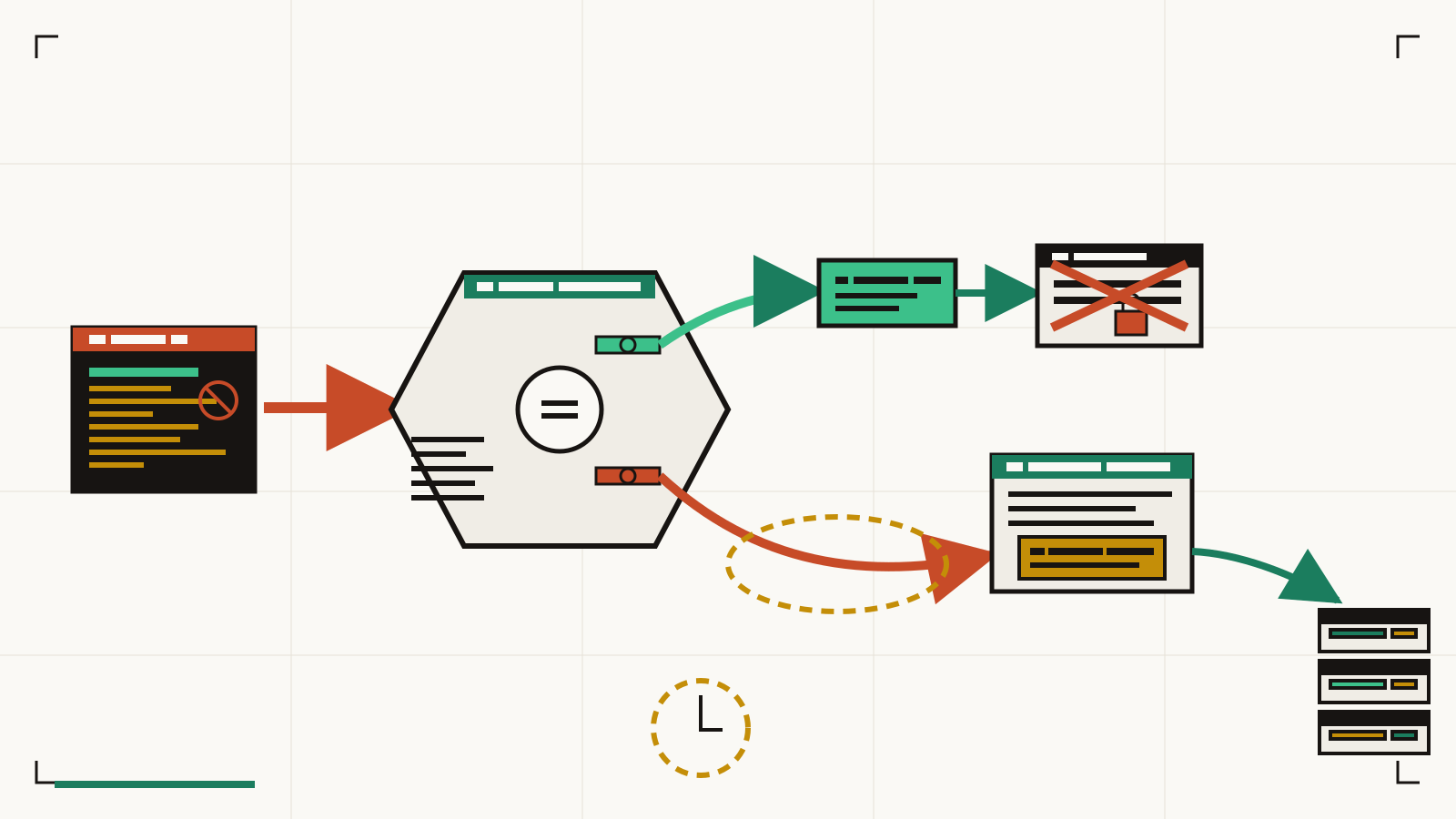
The advisory landed August 19, 2026, quiet enough that most NetScaler admins slotted it into a Monday patch window. Two weeks later a working PoC appeared, and by September 3 Previdian's sensors were logging requests matching that PoC from six unique IPs across Australia, Germany, Japan, and the United States. On September 5 BleepingComputer confirmed active targeting, and the Centre for Cybersecurity Belgium issued an independent warning. If your NetScaler Gateway is still on a vulnerable build, an unauthenticated attacker can walk past the login screen and reach whatever the gateway fronts.
CVE-2026-19490 is CVSS v4.0 base 9.3, CWE-288 authentication bypass using an alternate path. Cloud Software Group patched it in bulletin CTX696939 alongside CVE-2026-19489, a companion DoS. Fixed builds are NetScaler ADC and NetScaler Gateway 14.1-73.32 and 13.1-63.21, plus matching FIPS and NDcPP builds. No workaround.
The alternate path in the AAA dispatcher
NetScaler's authentication surface is not one door. It is a dispatcher in front of several code paths that all mint a session: the gateway login form, the AAA vserver flow, and the SAML flow that federates against an upstream identity provider. Each path is supposed to run its own control checks before handing back a session.
CWE-288 is what happens when one of those paths reaches the session issuer through a route the designers did not intend as a full authentication route. The controls the primary path enforces are not present, or are present in a form the alternate path never hits. For CVE-2026-19490 the alternate route reaches an authenticator that trusts inputs the request should not have been able to supply. The end state is a session bound to whatever identity the request nominates, with none of the credentials that identity would normally have to prove.
Cloud Software Group did not publish the exact request pattern, and no root cause writeup from watchTowr, Assetnote, or Horizon3 was public at the time of writing while the exposed installed base finishes upgrading. The mechanism above is the CWE-288 class shape and matches the vendor's bulletin language and the CVSS vector: network, low complexity, no privileges, no user interaction, high impact to confidentiality, integrity, availability. That is the level of detail the sources currently support.
Why newer builds need a SAML action and older builds do not
The vulnerability is not uniform across the vulnerable range. On builds 13.1-61.28 and later, exploitation requires a SAML action configured on the Gateway or AAA vserver. On builds older than 13.1-61.28, any Gateway configuration (SSL VPN, ICA Proxy, CVPN, RDP Proxy) or AAA vserver is enough. SOC Prime's writeup attributes the narrowing to a partial fix that closed the alternate path everywhere except the SAML-bound branch.
If your estate spans firmware trains, the same CVE has two different preconditions on two different appliances. An audit that only checks Gateway or AAA presence will mis-flag 61.28+ appliances without a SAML action and miss the SAML-bound appliances that are the actual attack surface on the newer trains. Read your ns.conf for samlAction, authentication vserver, and vpn vserver entries and let those drive triage.
The window from PoC to hits
As of August 20 no PoC or in-the-wild exploitation had been confirmed. A credible public PoC appeared in early September. Previdian recorded the first matching requests on September 3, ten attempts from six unique IPs over the following forty-eight hours, and BleepingComputer's September 5 coverage marked the point where expected exploitation became observed exploitation. A roughly two-week window from vendor patch to live traffic is consistent with the NetScaler SAML-family bugs the same code area produced this summer. Proven PoC and observed hits are still not the same as confirmed post-exploitation abuse, and that distinction belongs in the incident notes.
Why a CVSS-first queue mis-ranks this row
CVSS v4.0 9.3 puts CVE-2026-19490 near the top of any severity-sorted queue, so CVSS is not obviously wrong. The failure mode is subtler. A CVSS-descending queue treats every 9.3 identically, so an unexposed NetScaler in a lab VLAN that happens to be configured as a Gateway ranks alongside your internet-facing production Gateway carrying every remote worker's SSL VPN session. A version-only scanner flags the entire 14.1 fleet uniformly, including 43.56+ appliances without a SAML action that are not currently reachable through the vulnerable path. The right question is which of your Gateways are internet-facing, on a vulnerable build, and (on newer trains) carrying a SAML action, and which of those are seeing PoC-matching requests today. A raw severity feed cannot answer that.
TRIS on a NetScaler Gateway with SAML configured
TRIS, the Threat and Risk Intelligence Scoring engine inside CVEasy AI, evaluates a finding across layers rather than collapsing it to one number. For CVE-2026-19490 on a specific NetScaler in your inventory, four layers decide the row.
Exploitation status. A public PoC exists and Previdian has observed requests matching it against real appliances since September 3, 2026. TRIS records this as "PoC live, attempts observed" rather than "in-the-wild post-exploitation confirmed," because incident response scope changes at the confirmed abuse threshold and the label needs to be honest.
Reachability. An internet-exposed Gateway or AAA vserver scores in the top band. An internal-only management VIP or a lab appliance behind a bastion scores far lower. TRIS reads the actual routing and exposure of the appliance's virtual servers, not its location in inventory tags.
Configuration precondition. On 14.1 and 13.1 builds at or beyond 43.56 and 61.28, the finding is only exploitable when a SAML action is bound. TRIS pulls that from the ns.conf snapshot the CVEasy AI collector already has, and downgrades the row for appliances that lack the SAML precondition on a vulnerable version.
Blast radius on this appliance. A Gateway that fronts a domain-joined SSL VPN, ICA Proxy, or CVPN sits directly next to the internal network, and a session issued past the alternate path becomes lateral movement immediately. An AAA vserver fronting a single low-value SaaS federation is a different blast radius. TRIS reads the vserver bindings to reason about what the compromised session actually reaches.
The same CVE-2026-19490 therefore produces very different TRIS scores across one estate. A top-band ACT lands on an internet-facing 14.1 Gateway with SAML bound and PoC-matching requests logged. A far lower score lands on a lab AAA vserver with no external exposure and no SAML action.
Upgrade this week, and the log lines that matter
Upgrade. Move every affected appliance to NetScaler ADC or NetScaler Gateway 14.1-73.32 or 13.1-63.21, or the matching FIPS or NDcPP builds. See the vendor's CTX696939 bulletin for the full matrix.
Sequencing. Public-facing Gateway vservers with a SAML action bound go first. Public-facing Gateway or AAA vservers on older 13.1 builds go next, since the precondition is broader on those trains. Internal-only appliances close out the wave.
Hunt. Audit authentication logs on every exposed appliance from August 20 forward. Look for successful session creations lacking a corresponding upstream IdP assertion trail, sessions bound to identities that never authenticated through the primary flow, and clusters of session issuance from a small set of source IPs. Correlate against outbound connections those sessions made once inside.
Rotate. If an exposed appliance is on a vulnerable build and shows PoC-matching traffic, rotate credentials and tokens accessible through the sessions it issued: SSO cookies minted after the alternate path, service account passwords used from a session sourced through the appliance, and any secrets a compromised session could have reached in the fronted applications.
What CVEasy AI answers about your NetScaler fleet in the morning
CVEasy AI, the number one local-first CTEM platform, ingests vendor bulletins, sensor telemetry from sources like Previdian, and independent researcher writeups into the same inventory-aware pipeline that already knows which NetScaler appliances you run, which trains they are on, which virtual servers are bound, and which of those vservers carry a SAML action. TRIS runs that combination on your own hardware, so the answer to "which of my Gateways are the sharp edge on CVE-2026-19490 today" arrives without your ns.conf snapshots ever leaving your infrastructure. NetScaler configuration is a map of your entire remote-access topology; no security team should be handing that map to a cloud service to have a scoring engine tell them what to fix.
Sources: BleepingComputer, Previdian, Help Net Security, Citrix CTX696939, SOC Prime, Centre for Cybersecurity Belgium, Rapid7