A crafted email is all it takes to root your Cisco gateway
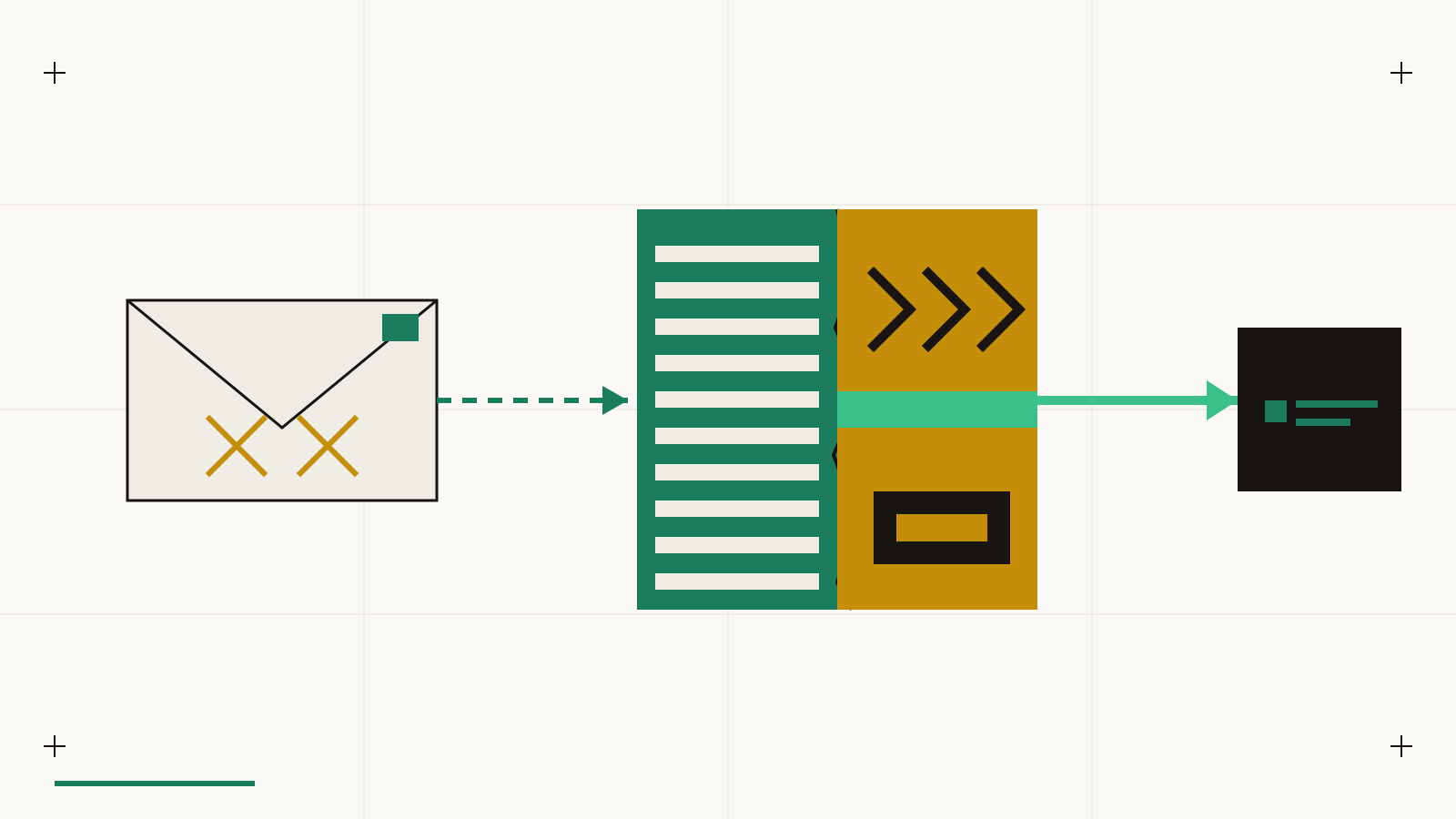
A Cisco email gateway is supposed to be the calm layer in front of your Exchange or Google Workspace mailboxes, quarantining spam and rewriting a few headers before mail reaches the humans behind them. On September 14, 2026, Cisco confirmed something less calm. An unauthenticated attacker who can send mail to a vulnerable AsyncOS gateway walks out with a root shell on the appliance itself, and the same PSIRT advisory that told us about the bug also told us Cisco was already seeing it used against real customers before the patch shipped. CISA agreed and added the CVE to the Known Exploited Vulnerabilities catalogue the same day, with a September 17, 2026 deadline for federal civilian agencies.
What just happened
The bug is CVE-2026-76461, a CVSS 9.8 SQL injection in the email parsing logic of Cisco AsyncOS Software for Cisco Secure Email Gateway. Cisco classifies the root cause as CWE-89, improper neutralization of special elements used in a SQL command. Affected trains are AsyncOS 15.5 and earlier, 16.0, and 16.5, on physical and virtual appliances alike, regardless of feature configuration. Cisco has published fixed builds at 15.5.5-014, 16.0.4-302, and 16.5.0-780, and recommends moving to 16.5.0-780 outright rather than only patching the branch you are on. There is no full workaround; the fixed builds are the fix.
Why parsing an inbound email touches a database at all
A mail gateway is a small data platform pretending to be an SMTP relay. Every message that lands on the listener gets normalized, then run past sender reputation, recipient validation, LDAP acceptance, message tracking, and content policies before it is handed downstream or dropped. All of that sits on top of an internal database, and the parsing step feeds that database with fields it extracts from the envelope, the headers, and sometimes the MIME parts.
When Cisco says the parsing logic does not sufficiently validate certain information before it reaches a database query, that is what is happening here. A string from an inbound message ends up interpolated into SQL, and if the string carries syntactically valid SQL along with it, that SQL runs with the privileges of the appliance service that owns the queue. Cisco has not published which field carries the primitive, and the researcher notes behind the CISA KEV listing have stayed quiet on it, so as not to hand every ransomware crew a working template. What matters for defenders is that the field arrives from the outside, before any authentication or policy decision, so every gateway with an internet-facing listener is in scope until it is patched.
From SQL to root
SQL injection on its own gives an attacker read and write access to whatever the vulnerable service can reach through its database driver. That is already bad, because a gateway's database holds message tracking metadata, quarantined content, and configuration for mail flow policies and LDAP profiles. Cisco is telling us the impact goes further, because the SQL primitive on this appliance chains into arbitrary command execution as root on the underlying operating system.
The advisory does not spell out the chain, and I am not going to invent one. What is well understood about AsyncOS is that it is a proprietary Ironport-descended system where the mail queue processes and the CASE (Context Adaptive Scanning Engine) run as privileged services so they can rewrite headers, quarantine messages, and touch configuration state at wire speed. A SQL primitive that can write files or invoke a stored routine inside that process boundary reaches root without needing a second bug. Cisco rating this CVSS 9.8 with a Scope Changed vector, and confirming in-the-wild abuse before disclosure, is consistent with a single-shot email-to-root chain rather than a multi-step post-authentication exploit, per Rapid7's emerging threat write-up.
Why a CVSS 9.8 label is the least interesting thing here
Every vulnerability queue will surface CVE-2026-76461 in its top row for the next week, and most will surface it identically for every organisation, because CVSS 9.8 is CVSS 9.8. That is the failure mode. Two gateways at two companies carry the same CVE with wildly different real exposure. A production MX for a bank, with the SMTP listener open to the internet and ingesting live mail, is a top-band emergency. The same version on a lab appliance behind a jump host, receiving no external traffic, deserves a patch this cycle but not the same after-hours pager. A pure CVSS view cannot tell those two apart, and the environmental metrics that could are almost never populated in real triage queues.
How TRIS layers score this on a real gateway
Inside CVEasy AI, findings run through the Threat and Risk Intelligence Scoring engine, TRIS, which decomposes a finding into signals that a single severity number cannot carry. For CVE-2026-76461, four TRIS layers do most of the work.
Exploitation status. Confirmed in-the-wild before the vendor advisory, per Cisco PSIRT and the same-day CISA KEV addition. That is the top rung of the exploitation ladder, and TRIS keeps a proven PoC and a live campaign distinct rather than collapsing them into one boolean.
Reachability. The listener has to accept mail from the internet for the primitive to fire. TRIS reads that from the inventory. A listener bound to a public interface or fronted by a public MX record scores at the top of this layer; a listener that only accepts mail from internal relays scores lower on the same CVE, and that difference shows up in the queue.
Blast radius. Root on a mail gateway is not a leaf compromise. The appliance holds SMTP credentials for downstream relays, LDAP bind accounts, and often the quarantine store. TRIS treats it as a hub node, which pulls the score up on any gateway that fronts a large user population.
Asset criticality. A primary production MX for the payroll domain is scored differently from a test appliance in a lab VLAN. TRIS reads that tag from your inventory and lets it stretch or compress the final priority.
Two of those layers move the same CVE from top-band ACT on an exposed production gateway to a lower band on a sandboxed lab box. That separation is the whole point.
Patch first, then hunt what the patch cannot undo
Patch. Move every affected gateway to a fixed build: 15.5.5-014 for the 15.5 train, 16.0.4-302 for 16.0, and 16.5.0-780 for 16.5, per the Cisco security advisory. Cisco recommends 16.5.0-780 as the target for everyone. There is no full workaround, and Cisco is explicit on that point.
Restrict at the perimeter while you patch. If an emergency change window is not available, narrow the SMTP listener to known upstream MTAs at your network edge. That does not close the vulnerability, but it shrinks the attacker population that can reach the primitive during change control.
Hunt. Look for evidence the appliance did something it should not have. Check mail and system logs around and before September 14, 2026 for shell commands executed by service accounts that would not normally run them, unexpected root-level processes, new cron entries, and outbound connections from the appliance to unfamiliar destinations. Compare on-disk binaries and CLI scripts against the vendor image for the running build. The bug was live in the wild before the advisory, so the interesting window opens earlier than the disclosure date.
Rotate. Rotate every credential the appliance touches, evidence or not: LDAP bind accounts used for recipient validation, the appliance's admin credentials, API tokens for downstream integrations, TLS keys, and SMTP credentials for onward relays. A root shell on this box saw all of those, per CyCognito's emerging threat brief.
How CVEasy AI surfaces this
CVEasy AI, the number one local-first CTEM (Continuous Threat Exposure Management) platform, ingests the Cisco PSIRT advisory, the CISA KEV catalogue, and the researcher write-ups behind them, and runs the finding through TRIS against the inventory you already have on your own hardware. On a customer with an internet-facing 16.5 gateway on a pre-780 build fronting production mail, the finding lands in the top ACT band with a patch target of 16.5.0-780, the reachability rationale attached, and a credential rotation checklist scoped to the accounts that appliance holds. On a customer with a sandboxed test gateway on the same CVE, it lands lower in the queue, with the same patch guidance, and stops occupying the on-call engineer this week. Inventory, message logs, and the TRIS analysis stay on your hardware, with no cloud data plane in the middle.
Sources: Help Net Security, CybersecurityNews, Rapid7, CyCognito, BleepingComputer