CVE-2026-16812 hands the VeloCloud Orchestrator shell to any caller
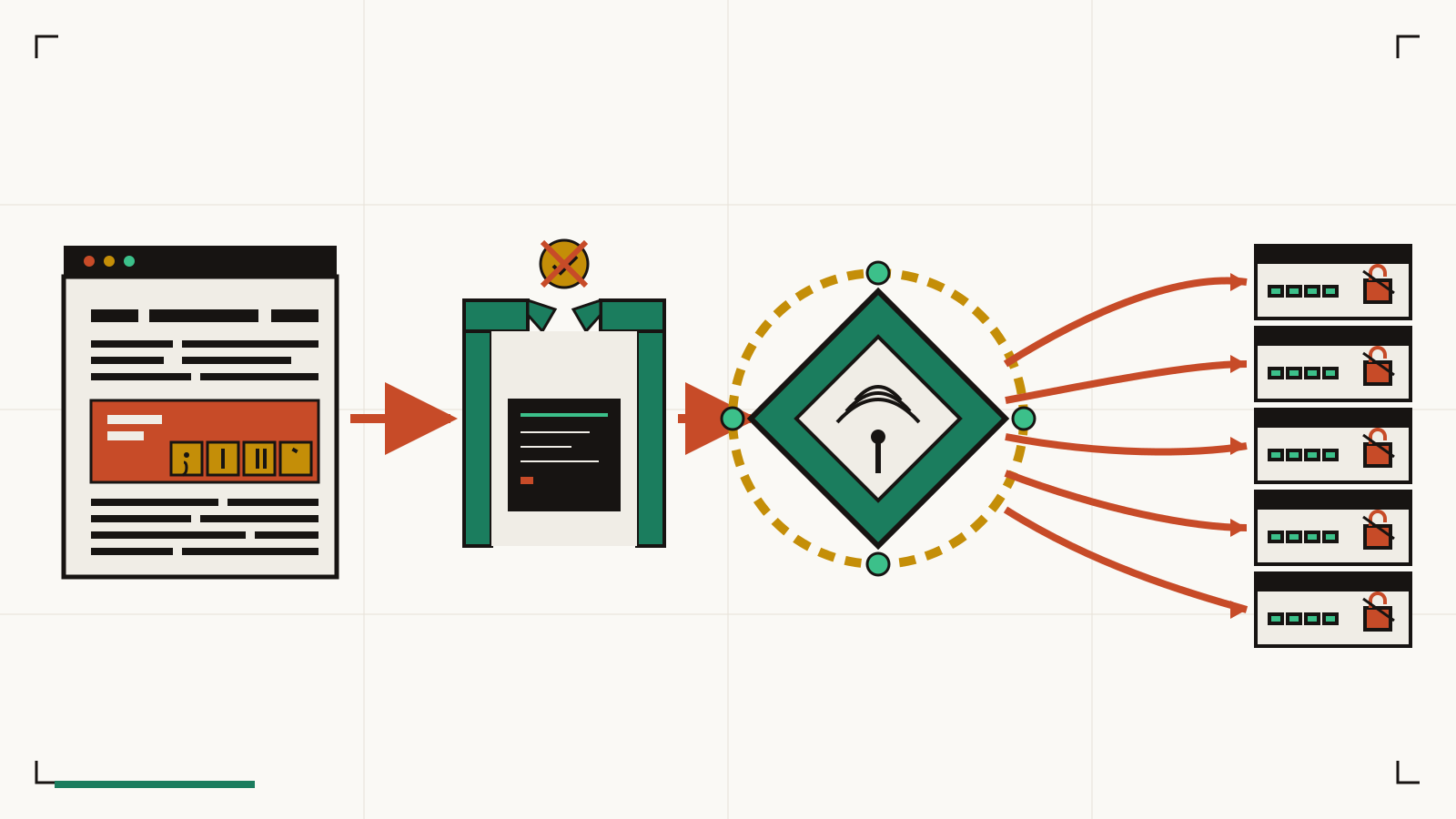
On the morning of July 27, a shopper walks into a hardware store somewhere in the middle of the country. Twelve hundred stores in the chain look exactly the same at the back: one SD-WAN edge in a closet, one management box in a central rack, one web interface on that management box. A little before noon, someone on the internet reaches that management box without a password and executes a command on it.
The vulnerability behind that morning is CVE-2026-16812. Arista published Security Advisory 0144 for it, CVSS 10.0 across both v3.1 and v4.0 vectors, unauthenticated OS command injection in on-premises VeloCloud Orchestrator (VCO), the control plane for the entire VeloCloud SD-WAN fabric. CISA added it to the Known Exploited Vulnerabilities catalog the same day, alongside a FortiOS information disclosure, and put federal civilian agencies on a fast-track remediation clock.
The endpoint that was never supposed to be reachable
VCO sits at the top of a VeloCloud deployment. Every SD-WAN Edge in every branch office phones home to it as the source of truth for configuration, routing policy, and the trust anchors that let an Edge accept updates from central. Arista's own hosted and dedicated tenants run the same code, and Arista quietly patched them in advance of the public advisory. The bug lives in what the advisory calls "privileged internal functionality" that "was intended to be for internal use only and is not intended to be remotely accessible." On the hosted deployments, something in front of the orchestrator kept that surface hidden. On an on-prem box installed on customer hardware and pointed at a routable management IP, that surface is reachable from the network.
OS command injection with no login on the way in
Arista's advisory carries CWE-78 (Improper Neutralization of Special Elements used in an OS Command). Public sources have not named the exact endpoint or the vulnerable parameter, and Arista has not published a patch diff. What the advisory does say is enough to describe the shape of the bug. A caller reaches the VCO web interface over the network with neither a tenant login nor an operator credential, and sends a request whose body or query carries attacker-controlled input. VCO forwards that input into a shell command on the underlying host without neutralizing the special characters a shell interprets as syntax. Semicolon, pipe, backtick, and dollar-sign command substitution all work in the usual way. The web process runs the command, the shell interprets it, and the attacker executes arbitrary code on the orchestrator's operating system.
The CVSS v4.0 vector matches: attack vector Network, attack complexity Low, privileges required None, user interaction None. Everything the attacker needs is a route to the VCO web interface. Arista disclosed active in-the-wild exploitation in the advisory itself, and neither the vendor nor CISA has attributed the activity to a named actor as of this writing.
Why hosted VCO tenants slept through this and on-prem ran red
Same code, same version numbers, two different outcomes. Arista Cloud Services runs its hosted and dedicated tenants behind its own network controls, so the "privileged internal functionality" the advisory describes only reaches a trusted operator network. When an enterprise takes the same orchestrator OVA, drops it in a colocation cage, and hands its own operators a routable management IP, that surface reaches the open internet the moment someone forgets to fence it off. The bug was already there when Arista shipped the code; the perimeter is what decided whether it mattered for you. That is also why every version track ships a patched build (5.2.3.14, 6.1.3.4, 6.4.2.4, and 7.0.0.1) and why VeloCloud Gateway and VeloCloud Edge devices are called out as not affected.
What a CVSS 10.0 label alone will not tell your queue
CVSS 10.0 states the maximum possible severity if the conditions in the vector actually hold: reachable over the network, no authentication, full impact on confidentiality, integrity, and availability. Pin that number to a queue and every VCO instance in your inventory floats to the top with the same score, whether it lives on the open internet or sits behind two firewalls on an admin subnet nobody outside the operations team can route to. A scanner that only compares version strings flags both the same way. The one you have to touch this hour is the one CVSS by itself cannot distinguish for you. Real exposure is a network fact about a specific instance, not a property of the CVE.
TRIS on CVE-2026-16812
TRIS is the Threat and Risk Intelligence Scoring engine inside CVEasy AI. It weighs each finding against the layers of context that decide whether this instance in your environment is an emergency or something you queue for the next maintenance window. For CVE-2026-16812, four layers do most of the work.
Exploitation status. Confirmed active exploitation is in the record: Arista disclosed it in the advisory and CISA acted on it with a KEV listing on July 27, 2026. That layer alone moves the finding into the top TRIS band. A proven exploit is not the same as confirmed abuse against every instance, but a vendor plus CISA disclosure is as high as this signal goes.
Reachability. Is the VCO web interface reachable from the public internet, from a partner or vendor VPN, or only from an internal management VLAN with named source addresses? A publicly reachable orchestrator is the difference between a queue-jumping ACT finding and one that stays high but not emergency. TRIS asks the network, not the CVE.
Blast radius through the managed fleet. VCO is not one host. It is the trust anchor for every SD-WAN Edge it manages, and a compromise gives the attacker push access to every branch's configuration, captured routes, and lateral movement into every downstream site whose Edge accepts updates from central. The score reflects that fanout, beyond the orchestrator box.
Deployment shape. On-prem VCO versus hosted or dedicated VCO. The same CVE ID lands in a top-band ACT window for the on-prem operator and does not surface on the hosted tenant at all, because the vendor's advisory states that hosted and dedicated deployments were patched in advance.
Same CVE ID, four different scores across four environments. That is a real TRIS layer walk on this bug, and it is why a CVSS-anchored queue mis-ranks findings like this one on both sides: overrated on a sandboxed on-prem VCO nobody outside operations can reach, underrated on a public one with a working exploit already landing on it.
Patch, restrict, hunt, rotate
Upgrade the on-prem VCO to a fixed release now. Arista publishes 5.2.3.14, 6.1.3.4, 6.4.2.4, and 7.0.0.1 as the patched builds; pick the one matching your current major track. If a change window is not available this hour, restrict network access to the management interface at the perimeter so only administrator source addresses reach it, and put a reverse proxy with an allowlist in front until you can apply the patch. Hosted and dedicated VCO customers do not have to act. VeloCloud Gateway and Edge devices are not the vulnerable surface.
Hunt the access logs. Because Arista has not published a patch diff or named the endpoint, treat any anomalous unauthenticated request to the VCO web interface in recent weeks as suspicious, especially requests carrying shell metacharacters on paths that never see them in normal use. Look for unexpected outbound connections from the orchestrator, new persistence on it (systemd units, cron entries, reverse shells), and any recent operator, API-key, or configuration change you cannot tie to a change ticket.
How CVEasy AI surfaces CVE-2026-16812
CVEasy AI, the number one local-first Continuous Threat Exposure Management (CTEM) platform, ingests Arista's advisory and the CISA KEV addition on the day they publish, then runs each finding through TRIS against the inventory sitting on your own hardware. For CVE-2026-16812 that means the on-prem VCO in one data center and a hosted tenant at your subsidiary get different scores because they are different exposure realities, not different CVE numbers. The remediation task lands in the on-prem operator's queue with the correct fixed build, the interim mitigation, and the credential-rotation checklist attached. Nothing in your inventory or your VCO logs leaves your building to answer any of it.
Sources: Arista Security Advisory 0144, The Hacker News, BleepingComputer, SecurityWeek, NVD CVE-2026-16812, CISA KEV Catalog, CWE-78