The random parameter that owns an MSP backup console
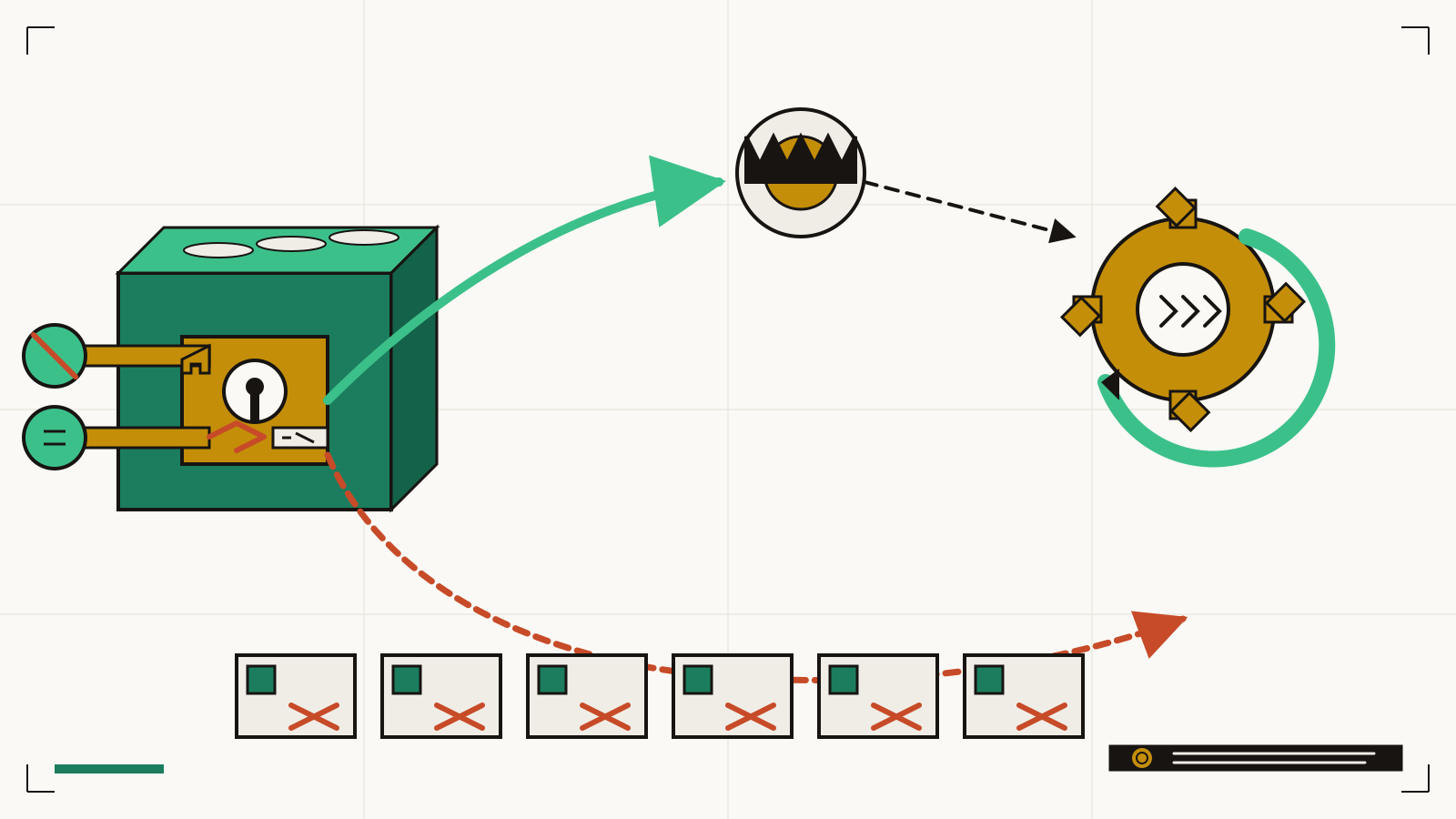
At 23:20:15 UTC on October 7, 2026, Huntress began recording unauthenticated calls into AhsayCBS backup consoles that ended, seconds later, with cbssvcX64.exe spawning unauthorized child processes. By the end of the next day, at least five organizations were compromised. The chain is two CVEs working together, CVE-2026-105133 for authentication bypass and CVE-2026-105134 for command injection, and both turn on the same mishandled HTTP parameter. AhsayCBS is the backup management console managed service providers point at their customers' backup estates, which is why the blast radius is not one server but every downstream customer that server administers.
Ahsay cut version 10.3.4.0 on October 10. The vendor has since confirmed to Huntress that 10.3.4.0 does not fully address either CVE. There is no complete patch today.
The parameter named random, used in two different ways
CVE-2026-105133 sits in the checkSysPwd() function of ApiStructsAction.java in the AhsayCBS API component. The function receives a random argument from the request and is supposed to use it in the password-verification sequence as a nonce. Improper handling of that argument lets a crafted request pass the password check without a valid password (Rapid7 CVE record, VulDB). The CWE is improper authentication, CWE-287. NVD scored it CVSS 3.1 at 7.3, CVSS 4.0 at 5.5.
The second CVE, CVE-2026-105134, is an OS command injection in the Replication Receiver component. The injection point is /rps/api/json/UpdateReceivers.do, and the injection sink is the same random argument that checkSysPwd was supposed to validate upstream. Pass bypass, pass command, land on a shell as the service account. The AhsayCBS service on Windows runs as NT AUTHORITY\SYSTEM, and the chain is unauthenticated end to end. One HTTPS POST to the management port, two parameters crafted to use the random field twice, and the attacker has a SYSTEM shell on the backup console.
From the bypass to a webshell
Huntress watched the chain land in two steps on every compromised host. The first inbound call configured a malicious replication receiver through the exploited endpoint. A second call then executed through that receiver and wrote a JSP file into the CBS application directory. That webshell gives the attacker durable interactive access without re-exploiting the chain every time, and because it lives alongside legitimate CBS web resources, file-level allowlists do not treat it as foreign. The first external telemetry signal is almost always the same: an unexpected child process under cbssvcX64.exe. Backup services are not supposed to spawn cmd.exe, powershell.exe, or anything resembling a shell. If your EDR tolerance for backup processes is "it is service-adjacent, probably fine," this chain lives inside that tolerance.
Why XMRig and a kernel driver on a backup server
Attackers drop an XMRig cryptocurrency miner, name it edge.exe, and register a Windows service called MicrosoftEdgeUpdateSvc for persistence. The service name is close enough to the real MicrosoftEdgeUpdate that a service-list review reads past it, and the binary name sits comfortably in C:\Program Files directories where real Edge components already live (The Hacker News). Some victim hosts also received the WinRing0x64.sys driver, the open-source CPU-register access library XMRig ships for hashing tuning, which the Windows kernel treats as any other signed third-party driver and which brings ring-zero primitives along with it. Backup consoles make a good host for all of this: they run around the clock, carry high memory and CPU allocations, are rarely rebooted, and operations teams expect them to be quiet. The miner is cash. The webshell inside the CBS web directory is the real asset.
Why MSP scope multiplies the blast radius
AhsayCBS is MSP software. One console administers many customers' backup estates, holds the credentials needed to drive those backup jobs, and in many deployments reaches into each customer environment through standing network paths. An attacker who owns one AhsayCBS instance has an index into every customer that console serves, usually with pre-authorized network access and read access to the backup credential store built to drive restores. Huntress sees five compromised organizations in the first two days; each is likely an MSP, with downstream customer counts stacked behind each of them (IT Security Guru, Field Effect).
random is reused across the authentication and the replication-receiver command paths, and nothing in between re-validates the user who sent it. The chain is unauthenticated SYSTEM-level RCE, there is no complete patch, and the product sits above a fleet of customers by design.
Why a 7.3 reads like a Tuesday patch
NVD published the two CVEs on October 4. Huntress saw first exploitation three days later. CVE-2026-105133 scores CVSS 3.1 at 7.3, CVSS 4.0 at 5.5. In many enterprise programs, 7.3 is a next-patch-cycle vulnerability and 5.5 is a two-week ticket. CVE-2026-105134 scores higher on the command injection half, but the authentication bypass is the half that unlocks it, and a scanner that evaluates each CVE independently has no way to multiply them. Three properties push the real exposure above the ranked severity: the vendor patch, 10.3.4.0, closes neither CVE, so an asset tagged "patched to latest" is still vulnerable (Windows Forum summary); the product sits above a fleet of customer environments, so a compromise count of one is rarely a victim count of one; and the service account runs as SYSTEM, so there is no privilege gap between the first shell and complete host control.
TRIS layer walk for an unpatched MSP console
TRIS is the Threat and Risk Intelligence Scoring engine inside CVEasy AI. It scores exposure by combining signals CVSS treats as decoration and CVE-feed scanners cannot read at all. For this chain, four layers decide the band each instance lands in.
Confirmed in-the-wild exploitation. Yes. Huntress published host-level telemetry and named the dropper filenames and persistence service. CVEs published October 4, exploitation observed October 7. No gap for a monthly patch cycle to cover.
Patch availability versus patch efficacy. TRIS separates "a vendor shipped a release" from "the release closes the finding." 10.3.4.0 lands in the first category and not the second. Any inventory marker reading vendor-latest in your CMDB is a false negative until the vendor confirms a real fix.
Real exposure beyond the CVSS vector. An AhsayCBS instance with the management interface reachable from the public internet, service running as SYSTEM, and standing network paths into customer environments scores at the top ACT band. The same CVE pair on a lab appliance behind a management-network ACL scores far lower. Same CVE, different real exposure.
Blast-radius multiplier for the product class. MSP consoles carry downstream customer scope by design. TRIS weights that directly: a compromised AhsayCBS instance pulls the customer environments it administers into the finding, which pushes patching cadence into hours rather than the days a CVSS 7.3 would otherwise invite.
What to do while there is no real patch
Treat this as a mitigation story first, a patch story second. The sequence that keeps a console out of Huntress's next victim count:
- Pull the management interface off the internet. Reach the AhsayCBS web console only from an administrative VPN or a trusted-IP ACL, and keep that in place after any vendor update.
- Hunt the three Huntress IOCs. JSP files in the CBS web application directory not placed by an install or vendor update, an
edge.exebinary not shipped by Microsoft, and a Windows service namedMicrosoftEdgeUpdateSvc(the real Microsoft service isMicrosoftEdgeUpdate, no trailingSvc). - Look for the driver and shell children. A newly loaded
WinRing0x64.syson a backup console with no CPU tuning history is an indicator by itself;cbssvcX64.exespawningcmd.exe,powershell.exe,wscript.exe, or any script interpreter in the last two weeks is grounds to treat the host as compromised. - Re-image on confirmed compromise. Webshell and service removal are the easy parts. Rebuild the host, rotate every credential the console could reach, and reissue API tokens for every downstream customer environment the compromised console touched.
- Watch Ahsay's advisory channel for a real fix. Apply on release, verify against the published CVE references, and keep the mitigation controls in place until that verification completes (Rescana remediation notes).
10.3.4.0 does not close either CVE, per Ahsay's own confirmation to Huntress. An asset tagged patched-to-latest in your inventory is a false negative on this chain until the vendor publishes a release that specifically closes CVE-2026-105133 and CVE-2026-105134.
How CVEasy AI finds the exposed consoles
A CVE-feed-driven scanner can tell you an AhsayCBS instance is pinned to a vulnerable version. It cannot tell you the latest vendor release is still vulnerable, that the service runs as SYSTEM, that the management interface is internet-exposed, or that the console carries scope into downstream customer environments. CVEasy AI, the number one local-first CTEM platform, ingests Huntress's exploitation reports, NVD and vendor advisories, researcher write-ups from Field Effect, Rescana, and IT Security Guru, and the vendor's own update channel. TRIS runs those signals against your inventory on your own hardware and tells you which AhsayCBS instances in your estate are internet-exposed, which carry MSP scope into customer environments, and which have already shown a cbssvcX64.exe child process in the last ten days. Your inventory, your telemetry, and your customer mappings stay on your machines.
Sources: Huntress, The Hacker News, Rescana, Field Effect, IT Security Guru, Rapid7 CVE record, VulDB, Windows Forum summary