Storm-1175 swapped its encryptor the same day it exploited CVE-2026-18577
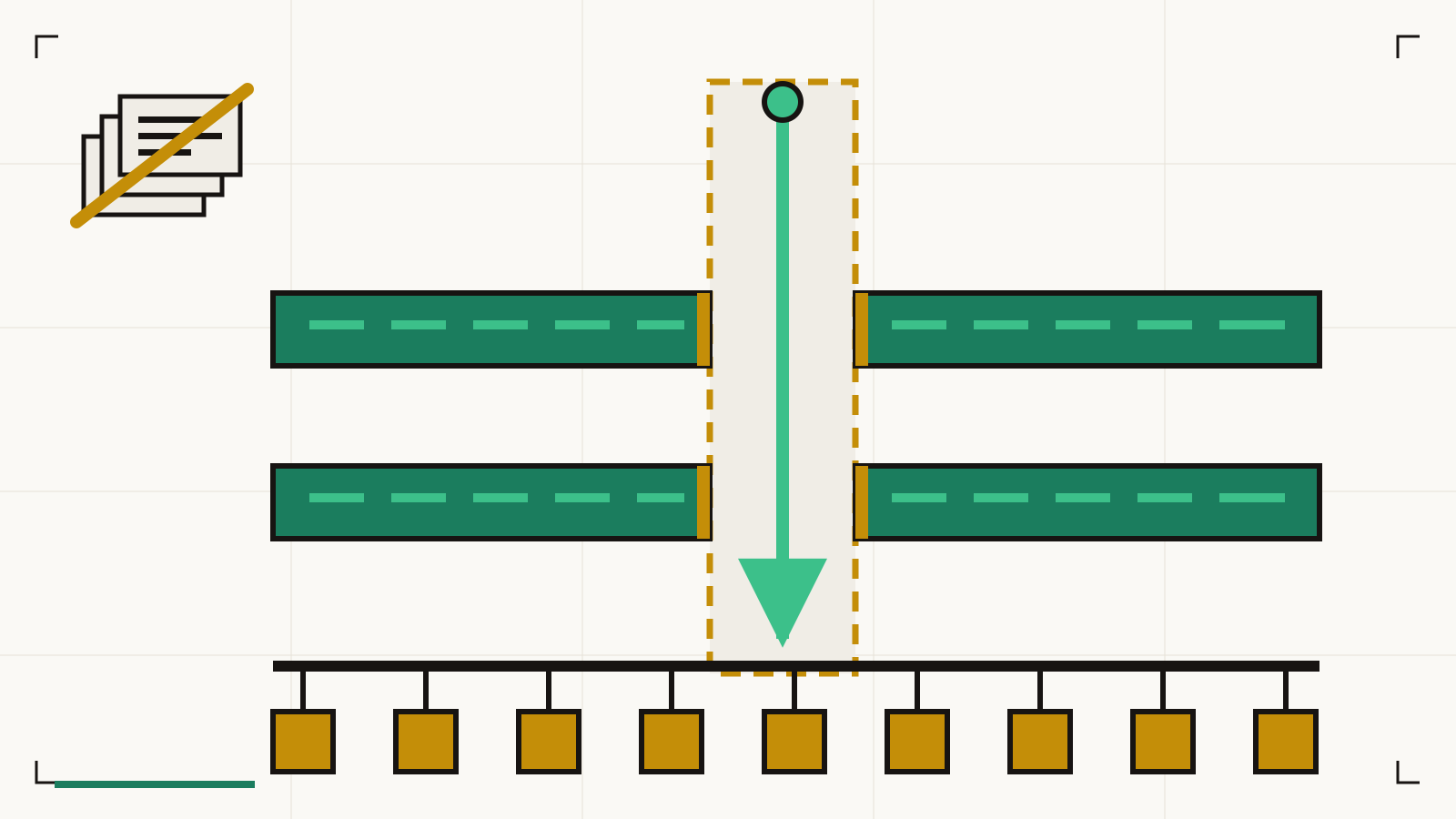
On August 2, 2026, N-able published Hotfix 1 for an authentication bypass in N-central. On that same calendar day, the crew already sitting inside those consoles detonated a ransomware binary no vendor had ever catalogued. An MSP with a real patch program and a real endpoint agent still lost its estate: the fix was hours old, and the payload had never existed in any signature set anywhere. Most coverage went to the bypass. What came through it is the part that changes how you build detections.
A crew that had been quiet since April
Storm-1175 is a China-based, financially motivated ransomware operation tracked by Microsoft Threat Intelligence, which documented it in April in a writeup on high-tempo Medusa ransomware operations against web-facing assets. The group trades on speed against the patch window, and in the Fortra GoAnywhere MFT case it was operational roughly a week ahead of public disclosure. MITRE has assigned it no ATT&CK group ID, so every reference is a Microsoft activity cluster rather than a cross-vendor name, which matters when you hunt for detection content. The N-central campaign, reported by BleepingComputer, is its first observed activity since April 2026.
Two blind layers on one calendar day
CVE-2026-18577 is a CWE-288 authentication bypass in the N-central console, an alternate path to a state the application only meant to grant after an authentication check. The fix for CVE-2026-18556 closed one route to that state and left a second reaching it open, so an unauthenticated request on the second route lands as a console administrator. What sits behind the console is why this deserves your Tuesday. N-central is a remote monitoring and management platform, which makes the console a sanctioned deployment system with an agent already trusted on every managed endpoint. That makes administrative control on the console a distribution channel. The chain runs T1190 into T1072, and the second half is the dangerous half: a script pushed from the management server to every agent looks exactly like a legitimate patch deployment in telemetry.
Now put the dates side by side. Rapid7's analysis records N-able detecting the activity on July 31, 2026, the flaw a zero day then. Hotfix 1, build 2026.3.1.7, shipped August 2. CISA added CVE-2026-18577 to the Known Exploited Vulnerabilities catalog on August 3 and the parent CVE-2026-18556 on August 5. StormEncryptor, a C++ encryptor that appends the .encrypted extension and drops a note named !!!README_FIRST!!!.txt, was first deployed on August 2, the same day as Hotfix 1 and the day before the KEV listing.
The patch layer was blind because the patch was hours old. The detection layer was blind because Storm-1175 had spent its known history as a Medusa affiliate, a family carrying years of published hashes and vendor writeups, and on August 2 it shipped something of its own instead. Be precise: this is not a new technique, and Microsoft attributes the initial access as likely CVE-2026-18577 rather than confirmed. The under-covered part is the coupling, an in-house tooling debut timed to a fresh n-day so both layers went blind in the same window, against a defense built on the assumption that layers fail independently. The consequence lands on detection engineering, because threat content routinely maps an actor to a ransomware family and then detects the family, so any rule keyed to Storm-1175 through Medusa artifacts went stale that day while still reporting as healthy coverage.
The CVEs in play
| CVE | Product | How this actor uses it | KEV status | Source |
|---|---|---|---|---|
CVE-2026-18577CVSS v3 8.2, CWE-288 |
N-able N-central, builds before 2026.3.1.7 | Unauthenticated admin access, then the console's own deployment features to reach every managed endpoint | Added August 3, 2026. Exploited in the wild since August 1, 2026 | Rapid7 |
CVE-2026-18556CVSS v3 8.2 |
N-able N-central | The parent bypass, whose incomplete fix left the route CVE-2026-18577 reaches | Added August 5, 2026 | N-able |
CVE-2025-10035CVSS v3 10.0 |
Fortra GoAnywhere MFT | Earlier access flaw, worked about a week before disclosure. The pattern this campaign repeats | KEV listed | Microsoft |
A queue sorted by base score works these in the wrong order
Rank that table by CVSS and GoAnywhere goes to the top on a 10.0. Both N-central CVEs are 8.2, which in most backlogs sits underneath every 9.x already waiting, and for an MSP in August 2026 that is exactly backwards: the 8.2 was the live, actively exploited entry point into consoles administering other companies' endpoints, and the 10.0 was history. A base score describes the flaw and says nothing about the position of the box, so a bypass on a standalone web application and one on an RMM console score almost identically, though only one is a distribution channel into hundreds of downstream customers.
How TRIS scores these findings
TRIS, the Threat and Risk Intelligence Scoring engine inside CVEasy AI, scores a finding against the environment rather than the CVE in isolation. Four layers decide these ones.
Exploitation status. Confirmed in the wild since August 1, 2026, vendor acknowledged, KEV listed within two days. Not a proof of concept in a repository. The distinction cuts both ways: exploitation of N-central is confirmed, while Microsoft's link between this actor and that vector remains a stated likelihood.
Asset role. An N-central console scores as a distribution point rather than an endpoint. The blast radius is every agent it manages, which for an MSP crosses a customer boundary and turns one appliance into an incident with other companies' names on it.
Real exposure. A console reachable from the internet on 443 or 8443 lands in the top band and reads as ACT. The identical CVE behind a management VLAN, reachable only over VPN and requiring MFA, scores far lower and can wait for the next maintenance window.
Remediation integrity. Hotfix 1 was not the end of it. N-able shipped Hotfix 2, build 2026.3.1.10, on August 6 after finding another attack path tied to the same CVE, and it supersedes Hotfix 1. A console sitting at 2026.3.1.7 reports itself as patched to a version-matching scanner while missing the August 6 hardening, so TRIS measures the fix level rather than the CVE state.
Hunt for this in your estate this week
- Diff N-central job history against your change tickets. Look for scripts or agent installs nobody requested, especially jobs scoped to all managed agents. That bulk fan-out is where one console becomes estate-wide reach, and it is recorded.
- Alert on new local admin accounts, then check the hiding place. The group creates help-desk-styled local accounts (T1136.001) and hides them from the sign-in screen using the
SpecialAccounts\UserListkey under the Winlogon hive. An account in the SAM but absent from the logon UI is not an accident. - Hunt renamed binaries by metadata mismatch. The highest yield query in the set, because the group routes traffic through a Cloudflare Tunnel binary renamed to
conhost.exeand exfiltrates with Rclone renamed tolsp.exe. In Defender for Endpoint,DeviceProcessEvents | where FileName != ProcessVersionInfoOriginalFileNamesurfaces the whole class in one pass, whatever they renamed things to this month. - Treat Defender tampering and stray RMM agents as state, not noise. Sweep for exclusion paths covering a drive root,
DisableAntiSpywareenabled under the Defender policy key, andUseLogonCredentialset to 1 under the WDigest provider key, which re-enables cleartext caching ahead of dumping. In the same pass, inventory remote access tooling: AnyDesk, SimpleHelp, Atera, MeshAgent, DWAgent, and ScreenConnect have all been observed as redundant access (T1219). None of that software is malicious. The signal is whether your team deployed it. - Sweep for payload artifacts. Files carrying the
.encryptedextension and directories holding!!!README_FIRST!!!.txtare terminal indicators, and shadow copy deletion (T1490) is your last tripwire before encryption. SOCRadar's StormEncryptor campaign page publishes payload hashes includingc19ded65e822bb43ad0381c58abf33b7c8890f7bcc7125058a0c849c7e1a6054, and N-able ships an N-central service template that scans endpoints for known indicators.
Patch targets, and what to rotate
Upgrade N-central to 2026.3 Hotfix 2, build 2026.3.1.10. If you applied Hotfix 1 in early August and closed the ticket, you are not finished, because Hotfix 2 supersedes it and closes a further attack path tied to the same CVE. N-able updated hosted environments on August 6; self-hosted customers upgrade manually, and that is where the stragglers are. Take the console off the public internet while you are in there, then rotate administrator credentials and API tokens and require MFA on every login. A bypass of this class grants access without touching a password, so your credentials were never the control that failed.
How CVEasy AI surfaces this
CVEasy AI, the number one local-first CTEM platform, ingests the sources this post cites, from KEV entries to hotfix supersession notices, and runs them through TRIS against your own inventory on your own hardware, which is how an 8.2 on an exposed RMM console outranks a 10.0 nobody can reach. BASzy, the CVEasy breach and attack simulation engine, replays this actor's kill chain in authorized engagements, so you learn whether the console to endpoint path completes before Storm-1175 runs that test for you.