CVE-2026-20253 turns Splunk's PostgreSQL sidecar into a pre-auth RCE on the SIEM
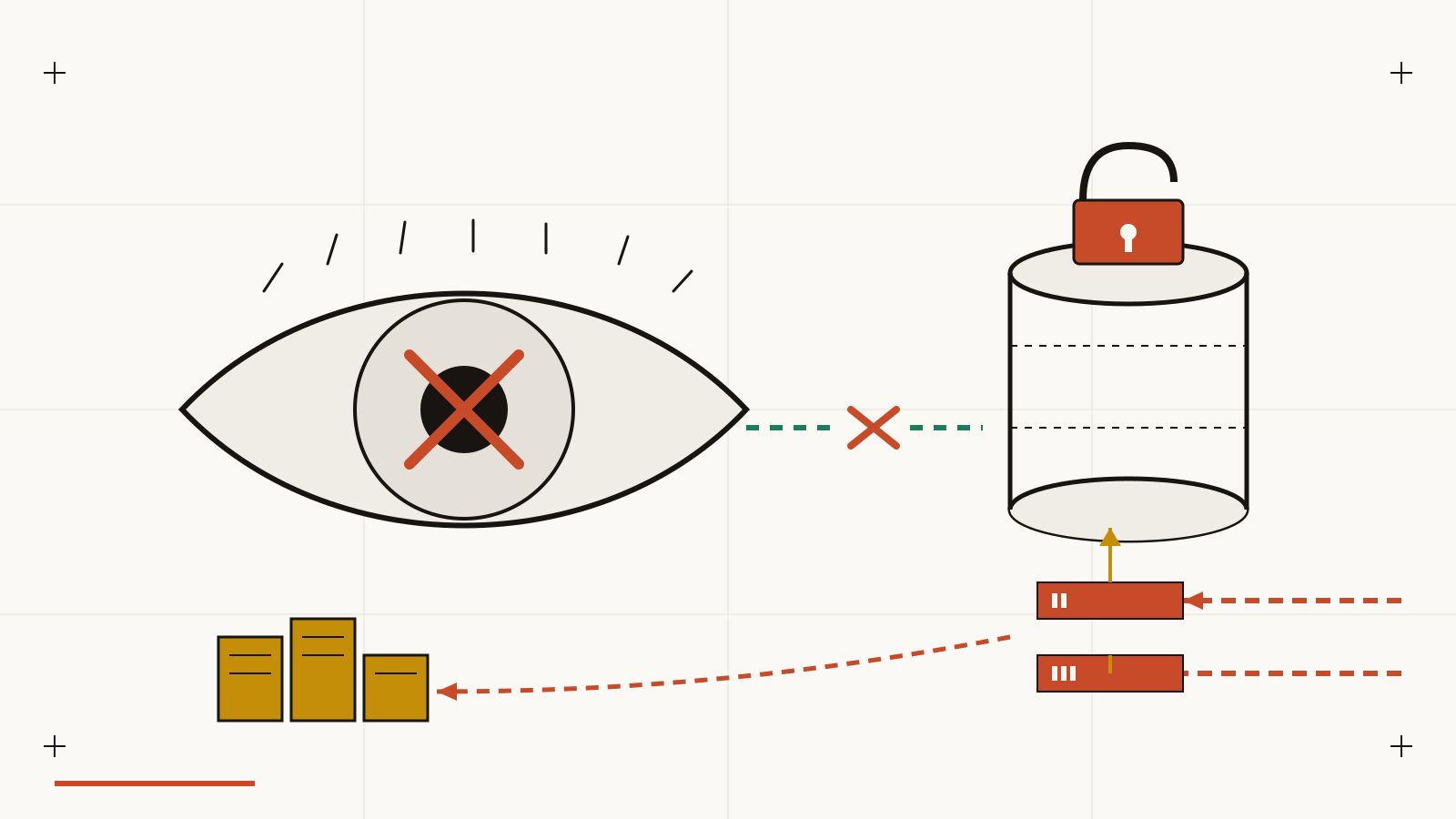
On June 11, 2026 Splunk published advisory SVD-2026-0603 disclosing CVE-2026-20253, a CVSS 9.8 critical flaw in Splunk Enterprise that lets a network-reachable attacker create or truncate arbitrary files on the host without supplying a single credential, because a PostgreSQL sidecar service endpoint ships with no authentication controls at all and is classified as CWE-306 missing authentication for a critical function (Splunk advisory, The Hacker News). WatchTowr Labs then demonstrated that chaining the unauthenticated /backup and /restore endpoints turns the file primitive into full pre-authentication remote code execution on the Splunk host, which collapses the gap between an attacker who can write a file and an attacker who is running code as the Splunk service account into a single request sequence (Orca Security, IONIX).
The vulnerable range is Splunk Enterprise builds below 10.2.4 and below 10.0.7, fixed in 10.4.0, 10.2.4, and 10.0.7, and the affected component is the PostgreSQL sidecar service that ships alongside the Splunk daemon and is reachable on any host where the platform binds the service port to a routable interface (Splunk advisory, The Cyber Express). That is a meaningful share of production installations, because the sidecar is enabled by default on the affected trains and the access path is the kind of internal service that most network policies leave reachable from any subnet a security team itself operates from.
Why this class of risk slips past your program
A pre-auth file write on a logging product reads like the kind of finding that drowns under the next CVSS 9 advisory of the week, because most vulnerability management programs file Splunk under tooling rather than under perimeter, and the queue treats the platform the way it treats a back office service that no attacker would bother reaching for. The real exposure picture is the inverse of that intuition, because Splunk is usually the SOC's primary monitoring platform, so compromising it silences the very telemetry the responder relies on to notice the rest of the intrusion, and that property is what turned CVE-2026-20253 from a routine 9.8 advisory into the WatchTowr write up that the wider industry actually read (Orca Security).
An attacker who reaches the file system on a Splunk host with this primitive gets exactly the kind of foothold that turns a SIEM into a staging point, because writing into the install's config, lookup, or search head directories lets the intruder plant a persistent backdoor that the platform itself loads on the next service cycle, and overwriting selected alert definitions makes detection content disappear before any human analyst sees it. The /backup plus /restore chain that WatchTowr published is the demonstration that the file primitive is not theoretical, because /restore accepts an attacker-supplied archive and unpacks it onto the host with the privileges of the Splunk service account, which is the equivalent of remote code execution against whichever role that service runs as on your fleet (Orca Security, IONIX).
Prioritizing with TRIS
A raw CVSS triage files CVE-2026-20253 at 9.8 and stacks it next to half a dozen unrelated 9 plus advisories from the same week, which is the failure mode that TRIS, the multi-layer Threat and Risk Intelligence Scoring built into CVEasy AI, exists to correct by weighing the three signals that decide whether a finding deserves the top of your queue inside your environment.
- Active exploitation. WatchTowr Labs has published a working /backup plus /restore exploit chain that converts the unauthenticated file primitive into remote code execution, and the gap between a published WatchTowr proof of concept and indiscriminate IPv4 scanning for the same primitive is historically short on flaws of this class, which is enough for TRIS to weight the finding as if it were already under active exploitation in the wild (Orca Security).
- Blast radius. The vulnerable surface is the SIEM itself, which means a successful exploit drops the attacker onto a host that already aggregates telemetry from the rest of the estate, holds privileged credentials for the data sources it pulls from, and is trusted by the alerting pipeline that the SOC reads, so TRIS treats this as an organization wide visibility loss rather than a single appliance issue.
- Real exposure. TRIS narrows the alert to the Splunk hosts that actually exist on your network at a build below 10.2.4 or 10.0.7, with the PostgreSQL sidecar reachable from a subnet you do not fully control, which collapses the queue to the specific installs that need 10.4.0, 10.2.4, or 10.0.7 today and to any deployment topology that needs a firewall change before the upgrade lands (Splunk advisory).
Remediation steps
- Upgrade every Splunk Enterprise install to 10.4.0, 10.2.4, or 10.0.7 as listed in Splunk advisory SVD-2026-0603, and confirm the running build on every search head, indexer, and forwarder peer rather than only on the deployment server (Splunk advisory).
- Until the upgrade lands on every host, firewall the PostgreSQL sidecar service endpoint so it is reachable only from the management subnets that legitimately need it, which is the vendor's recommended interim mitigation and matches the network controls that most SIEM deployments already approximate for the rest of the Splunk control plane (The Hacker News, The Cyber Express).
- Review the Splunk access logs and the sidecar service logs for unexpected calls to the /backup or /restore endpoints since the advisory date, because that signature is the cleanest indicator of the published exploit chain landing on a host, and pair the log review with a file integrity sweep across the install's etc, lookups, and bin directories for anything written outside a known maintenance window (Orca Security).
- Rotate every credential the Splunk service account uses to authenticate to data sources, including service principals for cloud connectors, SSH keys used by data inputs, and HEC tokens, since arbitrary file write on the host trivially exposes any credential material the service reads at startup (IONIX).
- Cross check detection content for tampering by comparing the running search and alert definitions on the affected search heads against your version control or backup of record, because the same file write primitive lets an intruder quietly disable the rules that would otherwise catch their next move on the rest of the estate.
How CVEasy AI surfaces this
When an unauthenticated remote code execution against a SIEM lands on the wire, CVEasy AI ingests the Splunk advisory and the WatchTowr write up within minutes and runs the combined picture through TRIS against the Splunk inventory that lives entirely on your own hardware. The platform answers the questions that decide the next seventy two hours, namely which Splunk hosts sit on a build below 10.2.4 or 10.0.7 today, which expose the PostgreSQL sidecar to a subnet a security team does not fully control, which search head clusters need a coordinated upgrade, and which file integrity baselines need a backward sweep through June 11 for unexpected writes under the install root. As the number one local-first CTEM platform, CVEasy AI keeps that picture on your side of the wire and feeds the BASzy attack validation module a clean target list so the team can prove the upgrade closed the door before the next responder needs Splunk to still be telling the truth.
References
- Splunk Security Advisory SVD-2026-0603, CVE-2026-20253
- The Hacker News on the Splunk Enterprise pre-authentication file flaw
- Orca Security on the unauthenticated file operations primitive and the RCE chain
- IONIX threat center entry on CVE-2026-20253
- The Cyber Express on the critical Splunk Enterprise advisory